Latest Blogs

Stay informed about our latest insights, company news, and industry trends directly from our experts.

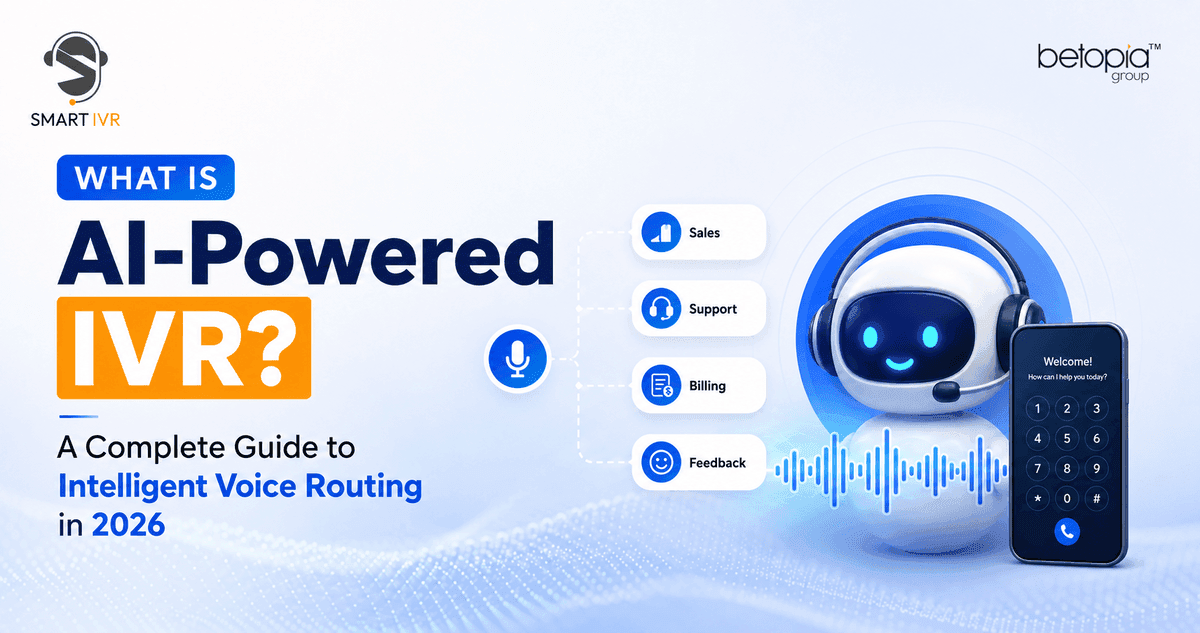
What Is AI-Powered IVR?  A Simple Guide to Smart Voice Routing in 2026
Product
Aug 9, 2026
Betopia Group

What Is AI-Powered IVR? A Simple Guide to Smart Voice Routing in 2026

Have you ever called a business and heard:

“Press 1 for Sales. Press 2 for Support. Press 3 to hear these options again.”

You choose an option. Then you wait. You may even get transferred to another person and have to explain your problem all over again.

This is a traditional IVR (Interactive Voice Response) system.

IVR has been helping businesses manage phone calls for decades. But traditional IVR has one big problem: it expects people to follow the system instead of understanding what people actually need.

That is changing with AI-powered IVR.

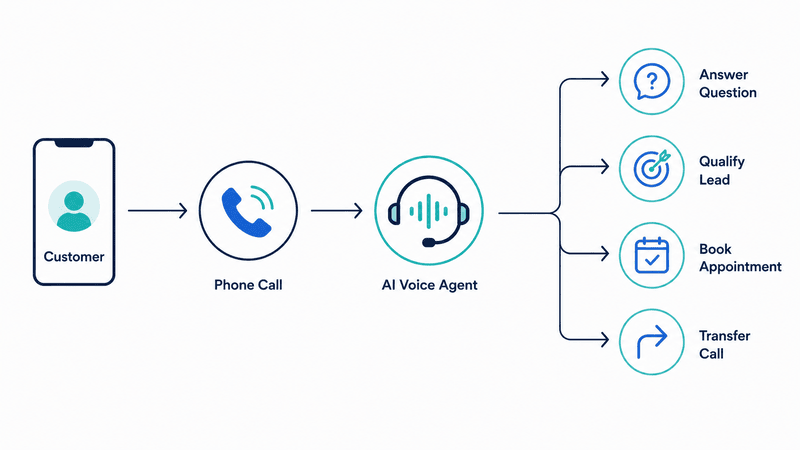
Also called Smart IVR or an AI voice agent, this technology can listen to what a caller says, understand the request, make decisions, answer questions, and send the call to the right person when needed.

In simple words, Smart IVR makes business phone systems easier for both customers and employees.

Let's see how it works and why it matters in 2026.

What Is AI-Powered IVR?

AI-powered IVR is a smart phone system that uses artificial intelligence to understand spoken requests and decide what should happen next.

Instead of asking callers to choose from a long list of buttons, it lets them speak naturally.

For example, a caller might say:

“I need to move my appointment to Friday.”

The AI can understand the request and check what should happen next.

If it is connected to a calendar, it may check available times and help reschedule the appointment.

If the request needs a human, it can send the caller to the correct employee.

So instead of:

Caller → Menu → Button → Department → Transfer → Employee

the experience can become:

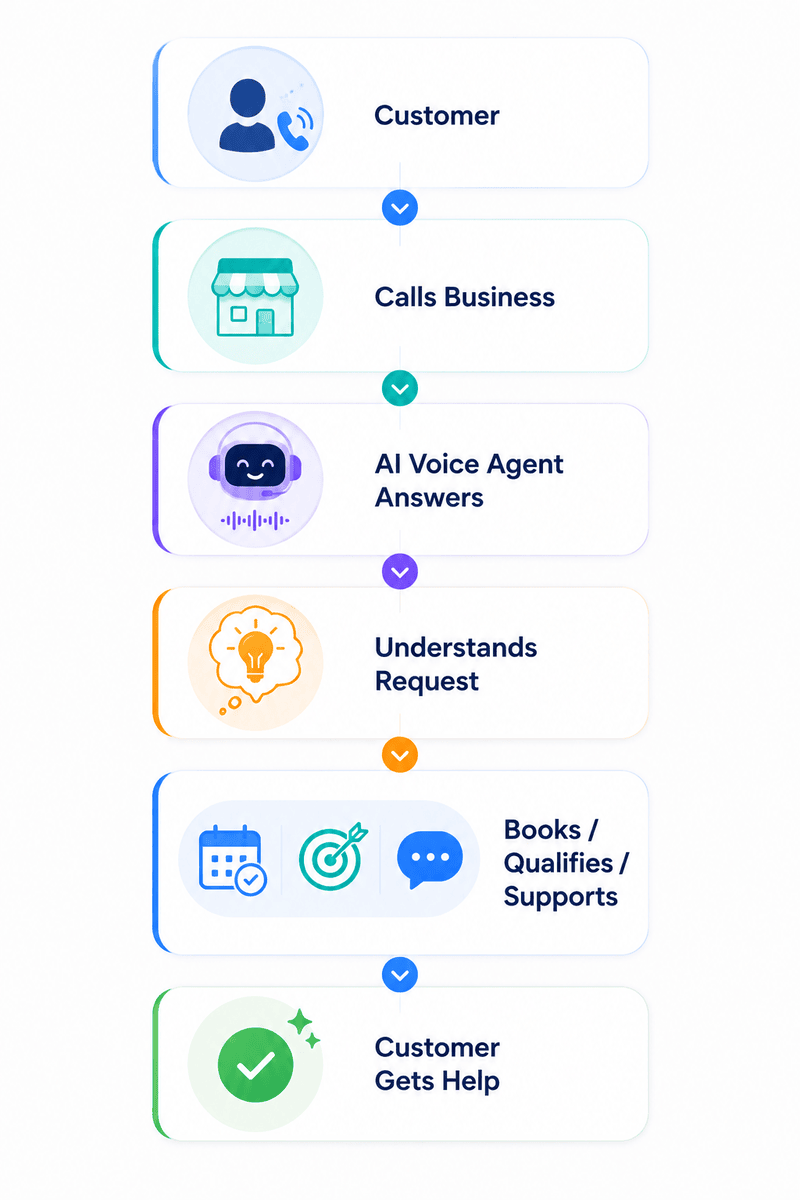
Caller → AI understands the request → AI solves or routes it

That is the basic idea behind Smart IVR.

How Does It Work?

AI-powered IVR combines several technologies to create a more natural phone conversation.

  1. It Understands What People Say
  2. It Makes Decisions During the Call
  3. It Talks Back Naturally

What Can an AI Voice Agent Do?

The real value of Smart IVR becomes clear when you look at everyday business tasks.

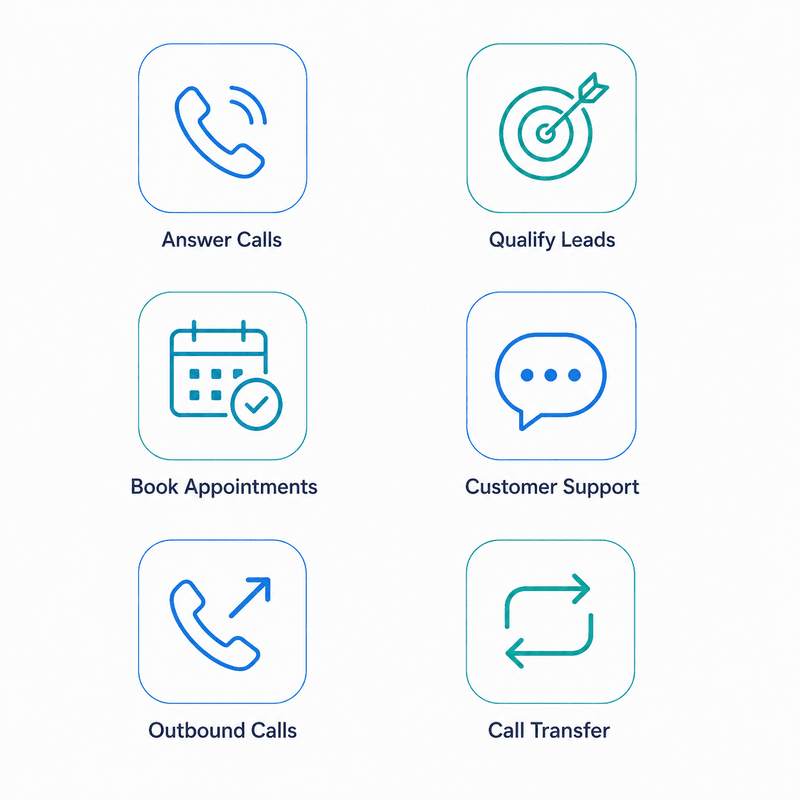
Answer Incoming Calls

An AI voice agent can greet callers, understand why they are calling, and either answer the question or send the call to the correct team.

This can reduce unnecessary transfers and help employees spend more time on important conversations.

Qualify Sales Leads

Imagine someone calls your business because they are interested in your service.

Instead of immediately sending the call to a salesperson, the AI can ask basic questions such as:

  • What service are you interested in?
  • What type of business do you have?
  • When do you need the service?
  • What is the best way to contact you?

The sales team can then receive a better-qualified lead.

Schedule Appointments

Appointment scheduling is one of the clearest uses for AI voice agents.

When connected to a calendar such as Google Calendar, the AI can check available times and help callers:

  • Book appointments
  • Change appointments
  • Cancel appointments
  • Confirm appointment times

This can save both customers and employees time.

Provide After-Hours Support

What happens when someone calls at 10 p.m.?

With a traditional system, the call may go to voicemail.

An AI voice agent can continue handling routine requests after business hours.

It can answer common questions, collect information, schedule appointments, or create a callback request.

This gives businesses a way to provide support beyond normal working hours.

Route Important Calls

Not every call should be handled by AI.

Some conversations need a real person.

A good AI voice system should recognize when a request is too complex, sensitive, or outside its capabilities.

It can then transfer the caller to the right employee with useful information about the conversation.

That means AI does not have to replace your team.

It can help your team focus on the calls that need human attention.

Why Businesses Are Moving to Smart IVR in 2026

Customer expectations have changed.

People are used to getting quick answers from search engines, chatbots, and AI assistants.

They don't want to spend 5 minutes listening to phone menus just to find the right department.

AI-powered IVR can help businesses create a faster and simpler phone experience.

The biggest benefits include:

  1. Faster Call Routing
  2. Better Customer Experience
  3. 24/7 Availability
  4. Lower Repetitive Work
  5. More Consistent Service
  6. Better Call Insights

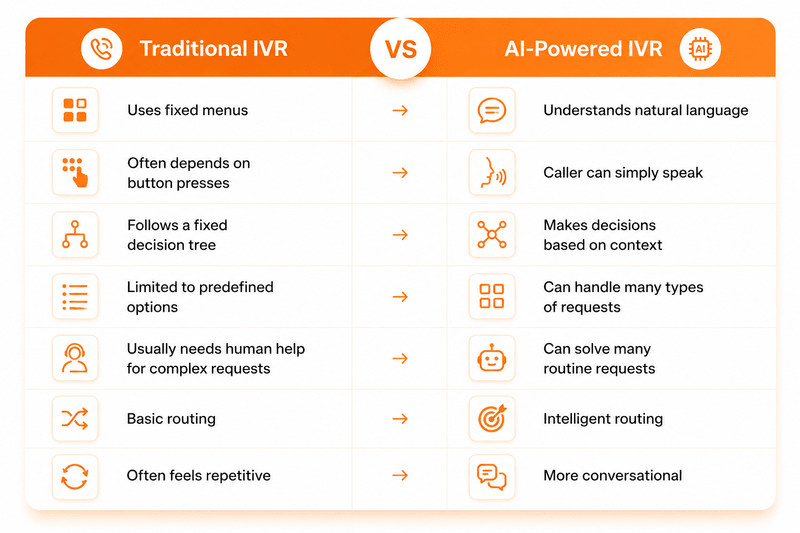
Difference Between Smart IVR And Traditional IVR

The biggest difference is simple:

Traditional IVR follows a menu. Smart IVR understands a conversation.

But when businesses want a better customer experience, AI-powered IVR can provide a much more flexible approach.

The Future of Business Phone Calls Is Smarter

AI-powered IVR is more than a replacement for the old “Press 1, Press 2” phone menu.

It changes the way businesses think about phone conversations.

Instead of making customers learn how your phone system works, the system can learn what the customer needs.

That is the real promise of Betopia IVR.

And as voice AI continues to improve, businesses will be able to connect phone conversations with calendars, CRMs, customer support platforms, internal knowledge bases, and other business systems.

The result can be a phone experience that is faster, more useful, and easier to manage.

Final Thoughts

The future of voice automation isn't only about having an AI that can talk.

It's about having an AI that can understand, act, integrate, and know when a human should take over.

That's the approach behind Betopia Group's Smart IVR solution.

Betopia Group offers a no-code voice agent platform designed to help organizations build and manage AI-powered phone experiences without requiring everything to be developed from scratch.

Betopia Group can help you move from traditional phone trees to smarter AI-powered conversations.

It isn't about replacing people.

It's about giving people a smarter system to work with.

And in 2026, that may be one of the most practical ways businesses can use AI.

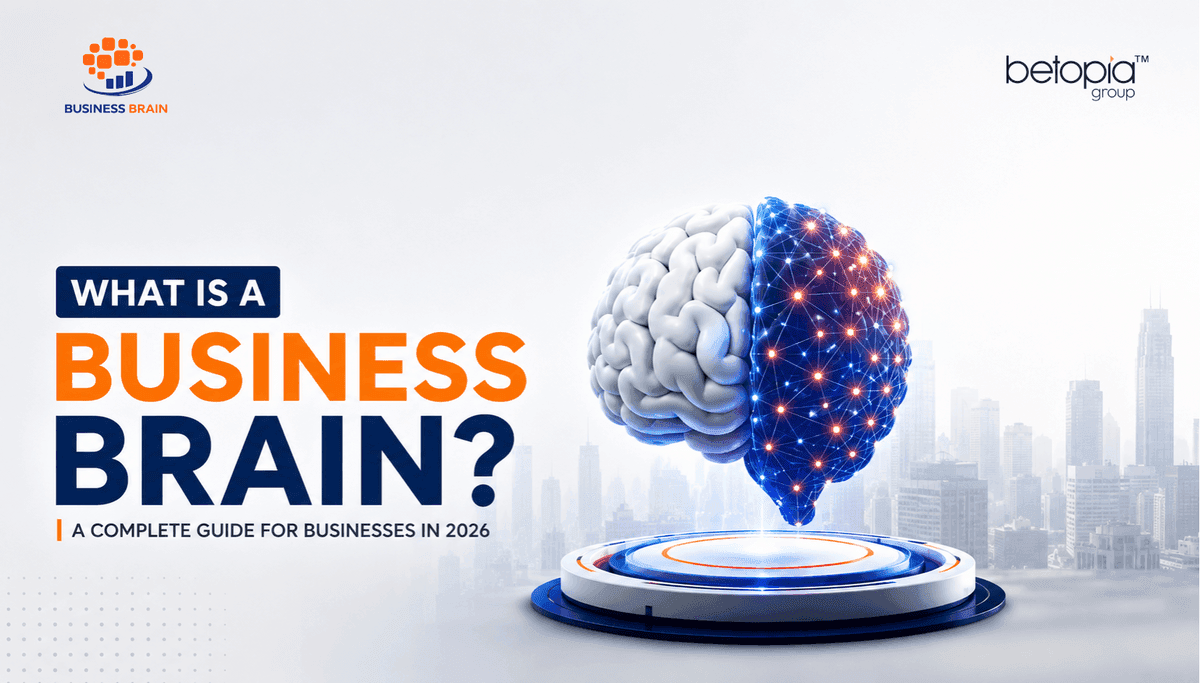
What Is a Business Brain? A Complete Guide for Businesses in 2026
Industry Insights
Aug 6, 2026
Admin

What Is a Business Brain? A Complete Guide for Businesses in 2026

Learn what Business Brain is, how this enterprise ERP platform works, and why growing businesses use it to manage finance, HR, sales, inventory, and multiple branches from one system.

You have more employees, more customers, more sales, and sometimes more offices or branches. Many businesses also use different software for different tasks. One system manages finance. Another manages HR. A third tracks inventory. Sales teams may even use their own tools.

At first, this worked.

But over time, these systems stop working well together.

Your finance team waits for reports from different branches. HR updates employee records in one system while managers check another. Inventory numbers don't always match. Leaders spend hours collecting information instead of making decisions.

This is exactly why many growing businesses choose an Enterprise Resource Planning (ERP) system.

One modern ERP solution is Business Brain, developed by Betopia Group.

Business Brain brings your entire business together in one secure platform. It makes it easier to manage people, processes, and data from one place.

What Is a Business Brain?

Business Brain is an enterprise ERP platform designed for organizations that want to manage all their business operations in one system.

Instead of using separate software for finance, HR, sales, inventory, and reporting, Business Brain connects everything into one platform. This means every department works with the same information.

When your sales team records a new order, your inventory updates automatically.

When payroll is processed, your finance records update instantly.

When management wants to see business performance, they can check real-time dashboards instead of waiting for reports.

Everything stays connected.

Why Do Businesses Need a Business Brain?

As businesses grow, they usually face some problem like -

  1. Information becomes scattered.
  2. Different teams use different software.
  3. Employees spend time entering the same data more than once.
  4. Managers wait too long for reports.
  5. Important decisions are delayed because nobody has the complete picture.

Imagine running 5 branches.

Each branch sends spreadsheets at the end of the month. Someone manually combines all the files before creating one financial report. If even one spreadsheet has a mistake, the final report becomes inaccurate.

Business Brain removes this problem.

Instead of collecting information from many places, every branch works inside one connected system. Everyone sees the same data. Everyone works faster.

How Does Business Brain Work?

Business Brain connects the most important parts of your business into one platform. Instead of switching between different applications all day, employees can complete their work inside a single system.

For example:

  • HR manages employees.
  • Finance manages accounting.
  • Sales tracks customers.
  • Inventory manages stock.
  • Management monitors business performance.

Everything is connected. Information moves automatically between departments. This saves time and reduces manual work.

It also helps leaders make decisions using real-time information instead of outdated reports.

The Main Features of Business Brain

Business Brain includes everything a modern organization needs to manage daily operations.

Here are some of its most important features.

Multi-Branch Management

Many ERP systems work well for one office.

The Business Brain is different.

It is built for businesses with multiple branches or locations. Every branch stays connected while management keeps full visibility across the entire organization.

Modular ERP Platform

Every business works differently. A manufacturing company does not have the same needs as a university. A hospital operates differently from a retail chain.

Business Brain uses a modular design. This means organizations can choose the modules they need without changing how their business already works. As the business grows, new modules can be added without replacing the entire system.

Real-Time Business Insights

Business decisions should not depend on yesterday's data.

Business Brain provides real-time dashboards that show important business information as it happens.

Managers can quickly monitor:

  • Sales performance
  • Revenue
  • Expenses
  • Inventory
  • Employee performance
  • Branch performance

Instead of waiting days or weeks for reports, leaders always know what is happening across the organization.

Better Financial Control

Finance is one of the most important parts of every business.

Business Brain helps organizations manage:

  • Accounting
  • Budgeting
  • Financial reports
  • Audit trails
  • Multi-branch consolidation

This makes financial management easier, more accurate, and more transparent.

Smarter Workforce Management

Managing employees becomes more difficult as organizations grow.

Business Brain helps HR teams manage:

  • Employee records
  • Attendance
  • Payroll

Sales and Customer Management

Keeping customers happy is easier when your team has the right information.

Business Brain includes a built-in Sales and CRM (Customer Relationship Management) module that helps businesses manage the complete customer journey.

Your sales team can:

  • Track leads
  • Manage customer information
  • Create quotations
  • Generate invoices
  • Follow sales opportunities

Instead of searching through emails or different software, everything is available in one place. This helps teams respond faster, close more sales, and build stronger customer relationships.

Smarter Purchase and Inventory Management

Managing inventory across multiple locations can be challenging. Without one connected system, businesses often face problems like:

  • Overstocking
  • Stock shortages
  • Duplicate purchases
  • Incorrect inventory records

Business Brain solves these problems by giving businesses complete visibility into their inventory. You can monitor stock levels, manage purchases, transfer products between warehouses, and track inventory in real time.

Who Should Use a Business Brain?

Business Brain is built for organizations that manage growing operations.

It is especially useful for businesses with:

  • Multiple branches or offices
  • Several departments
  • Large teams
  • Complex financial reporting
  • Growing customer bases
  • Expanding operations

It also works well across many industries, including:

  • Manufacturing
  • Retail
  • Healthcare
  • Education
  • Logistics
  • Banking
  • Government
  • Corporate enterprises
  • Service organizations

If your team spends too much time moving data between different systems, Business Brain can help simplify your operations.

Final Thoughts

As businesses grow, managing operations with disconnected software becomes more difficult.

  • Different departments use different tools.
  • Reports take longer to prepare.
  • Important information gets scattered.
  • Decision-making becomes slower.

Business Brain solves these challenges by bringing people, processes, and business data together in one intelligent ERP platform.

Business Brain is developed by Betopia Group, a technology company that helps organizations build smarter, more connected businesses.

Betopia Group delivers enterprise solutions powered by modern technologies such as ERP, AI, automation, cloud, cybersecurity, and business analytics. Every solution is designed to solve real business challenges while remaining simple, scalable, and future-ready.

If you're looking for an ERP platform that can simplify operations, improve visibility, and grow with your organization, Business Brain is a smart place to start.

Ready to simplify your business operations?

Discover how Business Brain can connect your finance, HR, sales, inventory, and reporting into one intelligent platform and see how Betopia Group is helping organizations build the future of enterprise technology.

How Betopia Vision 2030 Aligns With SDG 11 to Shape the Future of Sustainable Smart Cities
Vison 2030
Aug 4, 2026
Betopia Group

How Betopia Vision 2030 Aligns With SDG 11 to Shape the Future of Sustainable Smart Cities

What makes a city truly sustainable? Is it smart technology, green buildings, or something much bigger?

Most people think a sustainable city is full of electric buses, solar panels, and modern buildings. While these are important, they are only part of the story.

An actual sustainable city is a place where people can live safely, travel easily, breathe clean air, find affordable homes, and enjoy a better quality of life. Technology helps make this possible, but it cannot solve every problem on its own.

That is exactly what Sustainable Development Goal (SDG) 11 is about.

Created by the United Nations in 2015, SDG 11 aims to make cities and human settlements inclusive, safe, resilient, and sustainable by 2030. It is not just about building smarter cities. It is about building better places for people to live, work, and grow.

This is also where long-term innovation, education, and responsible technology become important. While Betopia Vision 2030 is not an official SDG initiative, many of its ideas naturally support the same long-term goals by focusing on research, digital transformation, engineering, and talent development.

What Does SDG 11 Really Mean?

Think of a city as a giant home shared by millions of people.

For that home to work well, everyone should have:

  • Safe and affordable housing
  • Reliable public transportation
  • Clean air and water
  • Parks and public spaces
  • Protection from floods, fires, and other disasters
  • Equal access to opportunities

These are the real goals of SDG 11.

Many people ask, "Is SDG 11 only about smart cities?"

The answer is no.

Smart technology is only one tool. The goal is to improve people's everyday lives. A city with advanced technology but poor healthcare, unsafe roads, or expensive housing cannot truly be called sustainable.

That is why SDG 11 includes multiple targets covering housing, transportation, disaster preparedness, environmental protection, cultural heritage, and better urban planning.

Why Does SDG 11 Matter More Than Ever?

Today, more than half of the world's population already lives in cities. By 2050, that number is expected to reach nearly 70%.

This means cities will continue growing rapidly.

More people need more homes, more schools, more hospitals, better roads, cleaner transportation, stronger digital infrastructure, and better public services.

Without careful planning, cities can quickly become overcrowded, polluted, and difficult to live in.

That is why SDG 11 is one of the most important goals in the United Nations 2030 Agenda. It helps governments, businesses, and communities prepare for the future instead of simply reacting to problems after they happen.

The Biggest Challenges Cities Face

Building a sustainable city is not easy.

Many cities around the world face similar problems every day.

Some people cannot afford proper housing. Public transportation becomes crowded. Roads become congested. Air pollution increases. Floods and heatwaves become more common because of climate change.

Many developing countries also face another challenge which is a growing digital divide. Some communities have access to modern technology, while others still struggle to access basic digital services.

These challenges cannot be solved with one app or one software platform.

They require good planning, strong leadership, continuous investment, and collaboration between governments, businesses, educational institutions, and local communities.

Real progress takes years, not weeks.

Sustainable Cities Always Put People First

When people hear the words "smart city," they often imagine AI, sensors, cameras, robots, and automation.

These technologies are exciting, but they should never become the main goal.

The most successful cities always focus on people first.

Technology should help people travel safely, receive healthcare faster, access education more easily, and enjoy a cleaner environment.

If technology only improves efficiency but leaves many people behind, it has missed the true purpose of SDG 11.

In other words, technology should support people but not replace them.

This simple idea is one of the most important lessons behind sustainable urban development.

Where Technology Makes the Biggest Difference

Although technology is not the entire solution, it plays an important role in helping cities grow more efficiently.

Cloud platforms allow different government departments to share information quickly.

Artificial Intelligence (AI) helps manage traffic, reduce energy waste, and improve city services.

Internet of Things (IoT) sensors can monitor air quality, detect floods early, and provide real-time information that helps cities respond faster during emergencies.

Cybersecurity is equally important because connected systems must remain safe from cyber threats.

At the same time, digital governance ensures that data is collected, stored, and used responsibly. Citizens need to trust that their personal information is protected while technology improves public services.

Bangladesh Has a Unique Opportunity

Bangladesh is growing quickly. Cities like Dhaka welcome thousands of new residents every day. This creates pressure on housing, transportation, healthcare, and public infrastructure.

At the same time, Bangladesh faces climate-related challenges such as flooding, rising temperatures, and natural disasters.

Instead of upgrading outdated systems later, Bangladesh can continue investing in modern digital infrastructure from the beginning. Better planning, stronger digital services, and skilled professionals can help build cities that are smarter, safer, and more prepared for the future.

However, technology alone is not enough. Sustainable progress also depends on good governance, quality education, skilled engineers, and long-term planning.

Why Innovation Ecosystems Matter

Installing advanced technology is only the first step.

The bigger challenge is maintaining, improving, and expanding those systems over time.

Imagine a city buying expensive software but having no trained people to operate or upgrade it. Eventually, the system becomes outdated, and the investment loses its value.

That is why innovation ecosystems are so important.

An innovation ecosystem brings together education, research, engineering, business, and technology in one connected environment. Universities produce skilled graduates. Researchers develop new ideas. Companies build practical solutions. Together, they create knowledge that continues growing for many years.

This approach builds local talent instead of depending only on outside expertise.

In the long run, this creates stronger and more resilient cities.

SDG 11 is not simply about building smart infrastructure. It is about helping communities develop the knowledge and skills needed to improve their cities for generations.

How Betopia Vision 2030 Aligns with SDG 11

Although Betopia Vision 2030 is not an official United Nations SDG initiative, its long-term vision naturally aligns with many of the principles behind SDG 11.

Rather than focusing on one product or one technology, Betopia Vision 2030 promotes innovation through education, engineering, research, digital transformation, and collaboration.

One example is Betopia Tech City.

Instead of trying to become a smart city itself, Betopia Tech City is designed as a self-contained technology campus where AI, cloud computing, cybersecurity, software development, education, healthcare, and research work together in one environment.

This approach helps develop skilled professionals, encourages innovation, and supports long-term technological growth.

As more businesses, researchers, educators, and technology experts collaborate, they create solutions that can contribute to smarter organizations and, over time, support broader sustainable development goals.

This is why Betopia Vision 2030 focuses not only on building technology but also on building people, knowledge, and innovation for the future.

Building Better Cities Starts Today

Many people ask, "Can one company achieve SDG 11?"

The answer is No.

Creating sustainable cities requires governments, businesses, universities, communities, and citizens to work together.

Another common question is whether technology alone can solve urban challenges.

Again, the answer is No.

Technology is a powerful tool, but it works best when combined with strong leadership, responsible governance, quality education, environmental planning, and community participation.

Final Thoughts

SDG 11 reminds us that the future of cities is about much more than digital innovation. It is about creating places where everyone can live safely, travel easily, access opportunities, and enjoy a better quality of life.

As cities continue to grow, the decisions we make today will shape how future generations live tomorrow.

Organizations that invest in education, research, engineering, and responsible technology can play an important role in supporting this journey.

This is where Betopia Group is working toward a long-term vision.

Through Betopia Vision 2030, the company aims to build an innovation-driven future by bringing together AI, cloud technologies, cybersecurity, software development, education, healthcare, and research under one collaborative ecosystem. Its vision is not to claim ownership of SDG 11, but to contribute to the broader goals of sustainable development by empowering people, developing local talent, and advancing responsible digital transformation.

Building sustainable cities is not the responsibility of governments alone. It requires innovators, educators, businesses, and communities to work together with a shared purpose.

At Betopia Group, we believe the future is built through innovation, collaboration, and continuous learning. By investing in people as much as technology, Betopia Vision 2030 seeks to help create a smarter, more sustainable tomorrow, one innovation at a time.

B2B Emailing Platform for Internal Communication: A Better Way to Reach Employees
Industry Insights
Aug 1, 2026
Betopia Group

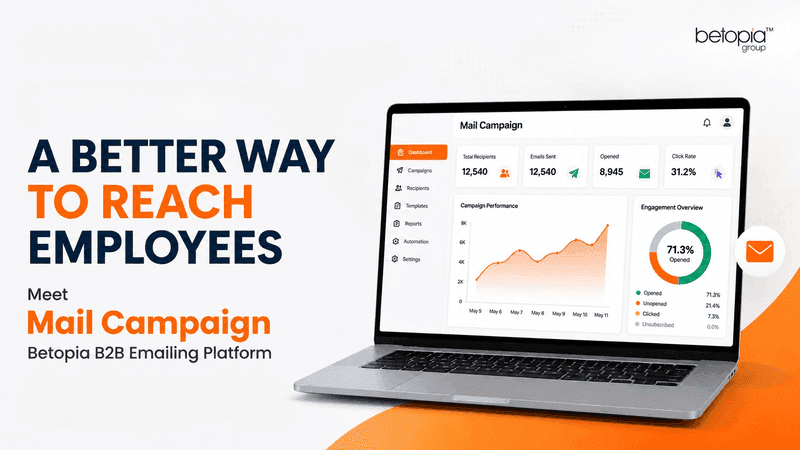
B2B Emailing Platform for Internal Communication: A Better Way to Reach Employees

Why Most Companies Still Can’t Reach Every Employee Instantly

Here's a simpler, more engaging version:

Try This Simple Test

Imagine you need to send an important message to everyone in your company.

What would happen?

In many mid-sized and large companies, the process is harder than it should be.

Someone exports an employee list from HR.

Another person uploads it to an email tool that was not designed for internal communication. Some emails fail because the list is outdated.

In the end, no one really knows how many employees opened or read the message.

This is a common problem. Companies invest in advanced tools for marketing emails with smart targeting, automation, and detailed reports. But internal communication is often managed with outdated tools and spreadsheets.

Why Internal Messages Get Harder as Companies Grow

When a company has 20 people, an all-hands email is simple. Everyone is on one list, most people read it, and if something goes wrong you can just ask around.

When a company has 2 thousand people, the same email touches many departments, different time zones, and people who do not need every update. Send everything to everyone and people stop paying attention. Send too little and rumors fill the empty space.

Most companies never built a proper system for this. They simply borrowed marketing tools because those were the tools that already existed. A system designed to sell products to strangers works very differently from a system that should talk to your own workforce.

The Privacy Problem Most People Ignore

Here is a question worth thinking about: When your company sends an internal announcement through a regular public email service, where does that information actually go?

Employee names, job titles, department details, and even who opened the message often pass through servers you do not control. For a simple retail newsletter this may not matter much. For a bank sending compliance updates, a hospital coordinating with staff, or a government office sharing internal directions, it is a real risk.

Public email tools were built for high-volume promotional messages. They were not built to protect the internal structure of an organization. As companies grow, the mismatch becomes more expensive and risky.

This is exactly the gap Betopia’s B2B Emailing Platform was created to close. The system can be hosted privately inside your own environment. Your communication stays inside your walls. No public exposure. No renting access to your own company structure.

A good internal email system should match the way a real company works.

You should be able to send a message only to the finance team. A message for senior leaders should be handled differently from a cafeteria menu update. Betopia's platform makes this easy with organization mapping. You can send messages based on department, seniority, or business unit.

Speed is also important. Sometimes leaders need to reach 10,000 employees right away. The system should deliver messages quickly. Betopia's one-click emailing feature is built for these moments.

Where AI Helps (and Where It Does Not)

AI is now included in many business tools, but it often does not provide real value.

AreaThe ProblemHow AI HelpsWhat Stays Human
Company-wide emailsThe wrong tone can confuse employees, and long or formal messages often get ignoredChecks tone and clarity before the message go es outThe writer decides what to say, and when
Employee repliesThousands of employees often ask the same few questionsSummarizes common questions and routes them to the right teamThe team decides how to respond

Measure the Results That Matter

Many companies send important internal emails but never know if people actually read them. Sending a message is only the first step. What really matters is whether employees opened it and understood it.

A good platform gives you real-time analytics. You can see delivery status, open rates, and engagement by department. Instead of saying, "We sent the email," you can say, "78% of the operations team opened it within one hour." This helps leaders understand what is working and what needs improvement.

Questions to Ask Before Choosing an Internal Email Platform

Before selecting a platform, ask these questions:

  • Where is our employee data stored after we send a message?
  • Can the platform match our company's departments and team structure?
  • Does it show real engagement data, or only confirm that the email was sent?
  • Can it work with our existing systems like AWS, Microsoft, or Google without requiring a complete migration?

The answers will help you decide whether your current system still meets your organization's needs.

Final Thoughts

Internal communication is often overlooked until something goes wrong. A message may reach the wrong people, fail to reach employees, or expose information that should stay private. When that happens, the cost can be much higher than expected.

If your organization is still using tools that were not designed for secure internal communication, it may be time to consider a better solution.

Look for a platform that protects employee data, reflects your company structure, and clearly shows whether employees are engaging with your messages.

Betopia's private mail campaign platform is built for these needs. It keeps employee data inside your own environment, supports your real organizational structure. It delivers messages quickly at any scale, and provides clear insights into employee engagement.

Why Your Software Releases Are Slow and How DevOps Can Fix Them
Industry Insights
Jul 28, 2026
Betopia Group

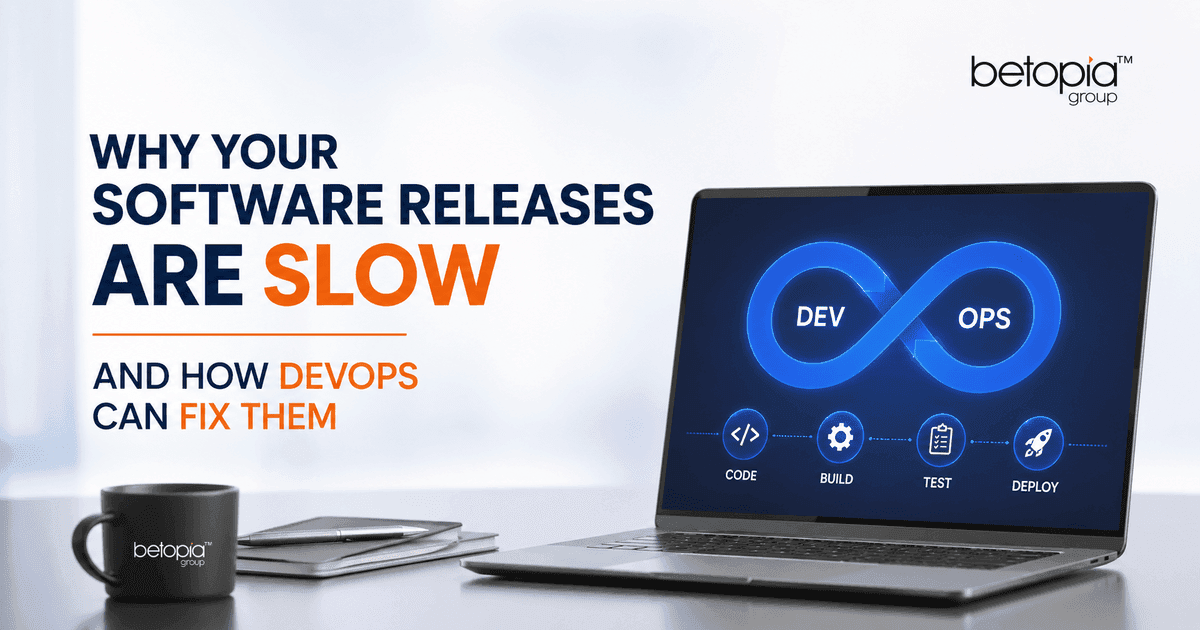
Why Your Software Releases Are Slow and How DevOps Can Fix Them

Why Hand-Done Software Releases Cause Trouble

You finished your software update on Friday.

Monday morning, the problems start.

Three angry messages.

One unhappy customer.

And no one can tell which change broke everything.

The setup that worked perfectly in testing never made it to the real system.

This happens more often than most companies like to admit.

It wastes time, money, and trust.

Why Doing Releases by Hand Keeps Hurting Teams

When people push out software by hand, three quiet problems keep appearing.

First, it is slow.

Someone has to click through many steps. Teams ship less often. That means big, risky changes instead of small, safer ones.

Second, it is messy.

A server set up by hand today almost never matches one set up three months ago. Tiny differences grow. Then something that worked in testing fails in real life for reasons no one can explain.

Third, it is hard to track.

When something breaks, finding exactly what changed becomes a long search instead of a quick check.

None of this is the team’s fault.

It is the process. People are not built to do the same careful steps the exact same way every single time.

CI/CD Makes Your Releases Calm and Reliable

CI/CD means the computer does the work for you.

Every time someone changes the code, a set of automatic steps tests it, builds it, and can even put it live. Same steps. Same order. Every time.

Think of it like a factory line instead of one person building everything by hand.

The factory line is faster and more consistent.

Small updates go out often.

Problems get caught early.

If something goes wrong, it is easier to fix because the change is small.

Infrastructure as Code: Servers Become Instructions Too

CI/CD decides what gets shipped.

Infrastructure as Code decides where it runs.

Instead of clicking buttons to set up servers, you write the setup in clear instruction files. Tools then build the servers the exact same way every time.

This stops a common problem called configuration drift - when test servers and live servers slowly become different.

With Infrastructure as Code, you can rebuild a whole environment in minutes and it comes out identical.

Put Safety Checks Inside the Process

Many teams still check for security problems at the very end.

By then, fixing a problem is expensive and stressful.

A better way is to put safety checks right inside the automatic steps.

Scans and rule checks run while the code is being built. Problems get found early, when they are cheap and easy to fix.

This approach is often called DevSecOps.

It is especially useful for banks, hospitals, and any company that must follow strict rules.

How to Begin Without Chaos

You do not need to change everything overnight.

Start by looking at your current process:

  • Where does work get stuck?
  • Which steps are still done by hand?
  • Where do mistakes usually happen?

Then automate one step at a time.

First the automatic pipeline. Later the servers. Then monitoring and safety checks.

Teams that try to do everything at once get overwhelmed. Teams that go step by step keep moving and see real results.

Three Simple Rules That Work

  1. Automate anything you do more than twice testing, checking, deploying, or rolling back.
  2. Catch problems early. A bug found while building costs far less than one found after customers see it.
  3. Do not patch live servers. Build a new one from clean instructions and replace the old one. This removes a whole group of hard-to-find bugs.

The Real Reason to Automate

Automation is not just about going faster.

It is about removing the quiet risks that build up when everything depends on one person remembering the right steps.

Ask yourself:

How long does a release take right now?

How often does something go wrong?

How much depends on someone remembering every detail?

Most teams that answer these questions honestly see the same thing, the old way is costing them more than they thought.

Betopia Group helps teams in banking, healthcare, education, and manufacturing make this change.

We build CI/CD pipelines and Infrastructure as Code that fits the way your team actually works, not a one-size-fits-all template.

The result? Faster releases. Fewer surprises. And far fewer Monday-morning fires.

5 Daily Tasks Your Business Should Hand Over to AI in 2026
General
Jul 23, 2026
Betopia Group

5 Daily Tasks Your Business Should Hand Over to AI in 2026

What’s quietly stealing hours from your team every single day?

It’s not the big meetings or tough decisions. It’s the small, boring, repetitive stuff. Chasing invoices, answering the same questions, fixing printer problems, and copying numbers into spreadsheets.

In 2026, smart businesses aren’t asking if they should use AI. They’re asking what to automate first. Here are 5 everyday tasks that are perfect for AI and why handing them over will save your team time and boost results.

1. Customer Support Triage

Most customer questions are simple and repeat over and over:

“Where’s my order?”

“How do I reset my password?”

“What are your hours?”

Answering these 50 times a day wastes your team’s energy. Customers also wait longer than they should.

AI solution: Tools like Talkora AI can answer these questions instantly 24/7 and only send the hard cases to a real person.

Result? Faster replies, happier customers, and support staff who focus on real problems instead of repeating the same answers.

2. Scheduling and Calendar Coordination

How many emails does it take to book one meeting? Too many.

Checking everyone’s availability, finding a good time, and confirming details is boring work that doesn’t need human creativity.

AI solution: A good AI assistant can check calendars, respect people’s preferences, and book meetings without the back-and-forth.

You’ll save hours every week and protect your team’s focus. No more losing momentum every time someone checks their calendar.

3. Data Entry and Document Processing

Invoices, forms, patient records, enrollment papers. Someone has to type all that information in.

It’s slow, boring, and full of mistakes.

AI solution: Modern tools can read documents, pull out the important information, and put it in the right system automatically.

If it’s Business Brain handling money data or Betopia EduOS processing student records, the result is fewer errors, faster work, and happier employees.

4. Internal Reporting and Status Updates

Every week, someone pulls numbers from different systems and builds a report. By the time it’s done, the numbers are already old.

AI solution: Smart platforms can pull live data and create reports automatically. It offers sales numbers, inventory levels, support tickets, you name it.

Leaders get fresh, accurate information instead of yesterday’s news. Platforms like Business Brain make this easy.

5. First-Level IT and Facilities Requests

“My password doesn’t work.”

“The printer is out of toner.”

“I need access to the shared drive.”

These requests come in all day, every day.

AI solution: A smart chatbot or IVR system can fix most of these common problems right away. Only the tricky ones go to the real IT or facilities team.

Staff get help faster. IT teams get time back for important work instead of toner requests.

How to Choose What to Automate First

Not every business needs the same things.

  • A school might start with scheduling and student forms.
  • A store might focus on customer support and sales reports.
  • A hospital might prioritize patient-related tasks.

The secret: Start with tasks that are repetitive, high-volume, and follow clear rules. These are the ones AI handles best.

Automation Is Not About Replacing People

Good automation gives your team back the parts of their day. It never needed them in the first place. People move from boring work to meaningful work, which is solving problems, helping customers, and growing the business.

Ready to transform how your team works?

Betopia Group specializes in exactly this. We help businesses in education, healthcare, and enterprise operations implement smart, integrated AI automation that actually works. We have Talkora AI for support, Business Brain for operations, Betopia EduOS for education, and CareOS for healthcare. Betopia Group builds complete solutions that turn repetitive daily tasks into smooth, automated processes.

If you’re tired of watching your team drown in small tasks that AI can handle better, Betopia Group is the partner that can help you automate with confidence and see real results fast.

Take back your team’s time in 2026.

Start with the right tasks, use the right tools, and let Betopia Group help you build a more efficient, productive organization.

7 Signs Your Business Needs Cloud Modernization
Industry Insights
Jul 23, 2026
Betopia Group

7 Signs Your Business Needs Cloud Modernization

Your servers just crashed again during the busiest time of the year. Sound familiar?

Many business owners feel stuck with slow, expensive, and outdated technology. They keep fixing problems instead of growing. Cloud modernization can change that.

Here are 7 clear signs it's time to modernize.

1. Your Team Spends More Time Fixing Systems Than Growing the Business

Does your IT team fix the same problems every week? Patching servers, restarting services, and handling crashes?

This is a major red flag. Old systems need constant care. Your best people end up doing maintenance instead of creative, high-value work.

Cloud modernization automates boring tasks like backups, updates, and scaling. Your team gets to focus on ideas that actually help your business win.

2. Costs Keep Going Up, But Things Don’t Get Faster

You spend more money on IT every year, yet everything still feels slow.

Traditional hardware forces you to buy too much “just in case” or too little.

In the cloud, you only pay for what you use. Resources grow or shrink automatically. Retailers handle holiday rushes and schools manage enrollment week without stress or extra cost.

3. Scaling Up Feels Like a Huge Project

A new market opportunity appears, but your systems take weeks or months to catch up.

Procurement, hardware orders, and long setup times kill momentum. Real business chances don’t wait.

Modern cloud systems let you scale in hours, not months. This gives fast-moving industries like retail, logistics, and finance a real edge.

4. Security Keeps You Up at Night

Old systems weren’t built for today’s threats. If you worry about outdated patches, unclear access rights, it’s time for change.

Cloud modernization brings strong identity controls, automatic monitoring, and smart threat detection.

Betopia’s cybersecurity and managed security services deliver continuous protection that goes far beyond occasional check-ups.

5. Your Apps and Data Don’t Work Together

How many different systems does your team juggle every day? Are they connected?

Most companies still copy data by hand, build reports manually, and make decisions with incomplete information.

Cloud modernization connects everything. Data flows automatically. Tools like Business Brain give leaders one clear, real-time view of the entire business instead of messy spreadsheets.

6. Remote and Hybrid Work Feels sticky

Working from home or on the road shouldn’t be difficult.

If employees struggle to access files securely, collaboration tools feel added-on, or IT tickets explode with every new location, your infrastructure is outdated.

Cloud systems are designed for modern work. Secure access, shared spaces, and smooth performance work from anywhere.

7. You Make Decisions With Old Information

Are leadership meetings based on last month’s numbers instead of today’s reality?

That lag hurts every part of your business. Cloud and analytics tools deliver live insights on sales, operations, customers, and resources as they happen.

This shift from old reports to real-time data is often where modernization pays for itself fastest.

What Should You Do Next?

Noticing one or two signs doesn’t mean panic. But if four or five feel the same, it’s time to move.

Start with a cloud readiness assessment. It reviews your current systems, data, security, and team skills. Most companies then modernize step by step: update key apps first, move data safely, and set up good rules so the new setup stays efficient.

Common questions answered:

  • Cloud modernization moves your systems to the cloud and improves how they work for better speed, lower cost, and easier growth.
  • It’s different from simple migration because it rethinks and optimizes everything.
  • Small projects take months; large ones may take a year in phases.
  • Small and mid-sized businesses often benefit quickly.
  • Done right with planning and testing, daily operations stay smooth.
  • When properly set up, the cloud is usually more secure than old on-premises systems.
  • Industries with lots of data or strict rules (healthcare, banking, education, government) gain the most.

Ready to Stop Maintaining the Past?

Cloud modernization is actually freeing your team, cutting waste, staying secure, and making smarter decisions faster.

Betopia Group helps businesses make this transition smooth and successful. From cloud strategy and migration to ongoing governance and security, their experts guide you every step of the way.

Stop letting old systems hold you back. Start building for what’s next.

Contact Betopia Group today for a cloud readiness assessment and take the first step toward a faster, smarter, more secure future.

How to Choose the Right Enterprise AI Chatbot in 2026
Industry Insights
Jul 23, 2026
Betopia Group

How to Choose the Right Enterprise AI Chatbot in 2026

A simple guide to picking the best enterprise AI chatbot in 2026. Learn what really matters, what to skip, and how to avoid costly mistakes.

Most Companies Pick the Wrong AI Chatbot – Here’s How to Get It Right

Your support team is drowning in tickets. Customers wait too long for answers. Simple questions eat up hours. Sound familiar?

You know you need an enterprise AI chatbot. But the market is packed with options, and most demos look exactly the same. Pick the wrong one and it becomes expensive shelfware in six months. Pick the right one and your team gets time back, customers stay happier, and costs drop.

This guide cuts through the hype. It shows you exactly what to look for in 2026.

Start With Your Problem, Not the Hottest Tool

Before you talk to any vendor, ask one clear question: What problem are we trying to solve?

  • Too many simple tickets?
  • Slow replies during busy times?
  • Staff stuck answering the same questions over and over?
  • Need to handle secure actions like refunds or appointments?

Different problems need different solutions. A basic chatbot for FAQs won’t work for tasks that require logging into customer accounts or connecting to your other systems.

The 6 Things That Actually Matter in 2026

1. Real Conversational Power

Skip chatbots that only match keywords. Good ones understand natural language, context, and follow-up questions.

Ask vendors to show how their bot handles messy, real-life questions, not just their perfect demo script.

2. Smooth Integration With Your Existing Tools

A chatbot is useless if it can’t talk to your CRM, helpdesk, ERP, payment system, or knowledge base.

Make a full list of the systems it must connect to. Demand real proof of integration, not just a checklist.

3. Strong Security and Compliance

In 2026, this is non-negotiable. Your chatbot may handle personal data, health records, financial info, or student records.

Look for clear answers on encryption, data storage, and compliance (SOC 2, HIPAA, GDPR, etc.). Vague responses are a red flag.

4. Smart Human Handoff

No chatbot is perfect. When it reaches its limit, it must pass the conversation to a human agent smoothly with full context. So the customer doesn’t have to repeat everything.

Poor handoffs make the experience worse than no chatbot at all.

5. Works Across Channels and Grows With You

Customers message via website, WhatsApp, SMS, voice, or apps, often switching between them. Choose a platform that handles all channels in one place.

Also watch for agentic AI. Basic chatbots only answer questions. Agentic systems can take action like processing refunds or updating records safely within set rules. This is a big leap forward.

6. Real Total Cost (Not Just the Sticker Price)

Licensing is only part of it. Factor in setup time, training, maintenance, and future changes. Ask for a clear 3-year cost breakdown.

Every Industry Is Different

A university needs a chatbot that understands class schedules and student records. A hospital needs strong privacy and appointment handling. A bank cares most about security and fraud protection.

Generic tools often fail here. That’s why industry-specific platforms perform better. They’re built for real workflows instead of being forced to fit.

Betopia Group stands out by creating tailored solutions. Their Betopia EduOS is designed specifically for education needs, while Betopia CareOS handles healthcare requirements. They focus on deep integration and practical results across education, healthcare, and enterprise sectors.

How to Test Before You Buy

Don’t rely on polished demos. Do this instead:

  • Grab 10 real customer questions from the past month (include tricky ones).
  • Ask shortlisted vendors to handle them live.
  • Watch what happens when the bot gets stuck.
  • Test the handoff to a human agent.
  • Review the reporting and analytics tools.

Vendors who welcome this test usually have something strong to offer. Those who push back are sending a clear warning.

What an Enterprise AI Chatbot Really Is

An enterprise AI chatbot is a smart system built for business use. It connects to your existing software, handles large-scale support, and automates processes securely.

Unlike basic chatbots that follow simple scripts or keywords, enterprise versions understand intent, maintain context, and scale across departments. They reduce repetitive work but don’t fully replace humans. The best setups use AI for routine tasks and route complex ones to your team with full conversation history.

Deployment usually takes a few weeks to a few months, depending on integrations. Success is measured by higher resolution rates, better customer satisfaction, smoother handoffs, and real time saved for your staff.

The Most Important Question

Don’t ask “Which chatbot has the most features?”

Ask: Which chatbot fits how my organization actually works?

The right choice quietly reduces friction. Your team and customers barely notice it because it just works.

Ready to Choose your Best Chatbot ?

Take time to test properly. Map your integrations early. Focus on real needs instead of shiny demos.

For organizations seeking integrated, industry-specific AI solutions that deliver real results, Betopia Group offers practical, well-matched systems built for education, healthcare, and enterprise environments. Their platforms are designed around actual operational challenges rather than generic templates.

Start your evaluation with clear goals. The right enterprise AI chatbot in 2026 can transform your customer service.

AI Analytics in 2026: What Actually Works for Business
Industry Insights
Jul 23, 2026
Betopia Group

AI Analytics in 2026: What Actually Works for Business

Find out how AI analytics helps businesses predict trends, reduce risks, and improve decisions in 2026 without unnecessary complexity.

What if your computer could warn you before your best customer leaves?

Or tell you a machine will break next week !

That is the power of AI analytics today.

But many leaders feel confused. They hear "AI analytics" and think of expensive tools or reports that no one reads.

This article explains it in very simple words. No tech talk. Just clear ideas that work.

What AI Analytics Really Means

Old business tools only answer questions that you ask.

Like: "Why did sales go down?"

AI analytics is different. It finds hidden problems and new chances you did not think about.

It can see a customer might leave soon. It can link a small delay in one place to bigger trouble later.

It does not just give fast reports. It shows things humans might miss in too much data.

Why 2026 Is a Big Year for AI

Before, only huge companies could use AI analytics. It cost too much and needed expert teams.

Now it is easier. Cloud services and ready AI tools let small and medium businesses start too.

Companies that start early get ahead. Good data helps make better choices. Better choices bring more good data. It grows stronger over time.

Which Fields Use It Best

  • Banks: Find fake transactions fast and make smart loans.
  • Hospitals: Guess which patients may come back and plan staff better.
  • Factories and delivery: Predict when machines break and fix supply problems early.
  • Schools and colleges: Spot students who need help before they fall behind.

In all these places, AI helps people make better decisions.

The Big Secret: Your Data Must Work Together

Most companies have lots of data. But it lives in different places. Sales in one system. Complaints in another. Money numbers in old files.

AI needs clean and connected data. Without that, even smart tools give wrong answers.

Fixing data is not exciting work. But it is the most important step.

What Good AI Analytics Looks Like

Good systems do these things:

  • Answer one clear question. Example: "Which customers may cancel in 60 days?" Not just "tell us about customers."
  • Explain why they give an answer.
  • Fit into normal daily work. Easy for managers to use.
  • Keep learning and get better with time.

Smart companies see AI as a regular tool, not a one-time project.

Common Mistakes to Skip

Big mistake: Buy AI tools first, then ask what to do with them.

You get nice screens but no real change.

Better way: Pick one decision you make every week or month. Ask what extra information would help. Then get the right tools.

Many people ask: Is this only for big companies? No. Small businesses can use it if they have repeated decisions that need better guesses.

How long will it take to see results? If your data is ready, in a few months. If data is messy, fix that first.

AI Helps People - It Does Not Replace Them

AI can say a customer may leave. But it cannot tell you the best words to keep them.

AI can warn about a bad supplier. But humans decide if the relationship is still good for other reasons.

The best companies use AI to help their teams think faster and smarter.

How to Start Without Big Risk

Do not make a huge plan. Start small.

  1. Find one place where decisions use guesswork.
  2. Look at the data you already have.
  3. Test a simple AI idea and see the value.

Small successes build trust and skills fast.

You do not need to replace old systems. AI usually works with them.

Ready to Make Smarter Moves in 2026?

AI analytics in 2026 is not about changing how you run your business. It is about giving your team better information.

Those companies make an impact who have clean their data, solve real problems, and keep improving.

Betopia Group helps businesses do this the right way. They start with your important decisions, fix your data, and build simple AI tools that give real results.

From better daily views with Business Brain to full AI and analytics help, they focus on what actually works for you.

Ready to make smarter choices? Book a 30 minute meeting with Betopia Group today. Turn AI from a confusing word into a real business advantage.

Your better future starts with one good decision. Together, we can transform your data into limitless business opportunities.

What Is ERP? A Simple Guide for Businesses in 2026
Industry Insights
Jul 22, 2026
Betopia Group

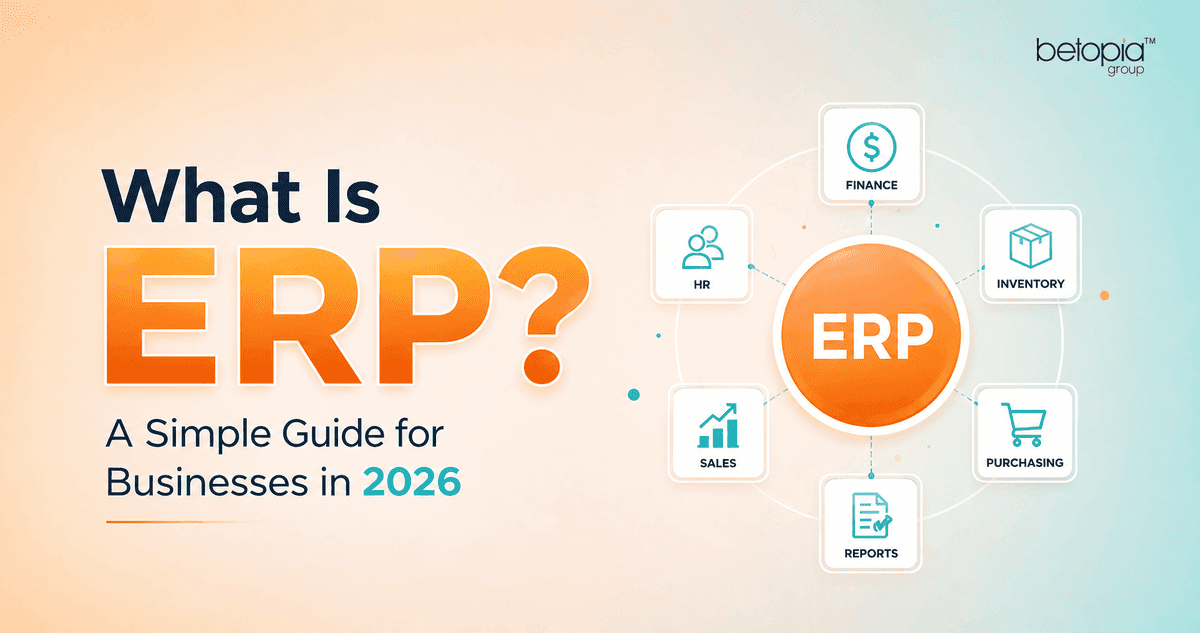
What Is ERP? A Simple Guide for Businesses in 2026

Learn what ERP is, how it works, its key features, and why AI-powered ERP is helping businesses grow faster in 2026.

Running a business is not easy.

You have to manage sales, inventory, finance, employees, customers, and many daily tasks. As your business grows, managing everything with different software or spreadsheets becomes difficult.

Information gets lost. Teams make mistakes. Reports take too long.

This is where an ERP system can help.

ERP brings all your business operations into one system. Everyone works with the same data, making work faster, easier, and more accurate.

In this guide, you'll learn what ERP is, how it works, and why businesses are choosing AI-powered ERP in 2026.

What Is ERP?

ERP stands for Enterprise Resource Planning.

It is software that helps you manage your entire business from one place.

Instead of using separate tools for accounting, sales, inventory, HR, and purchasing, ERP connects everything in one system.

When one department updates information, everyone sees the latest data instantly.

Think of ERP as the brain of your business. It keeps every department connected and helps everyone work together.

How Does ERP Work?

ERP works by sharing information between different departments automatically.

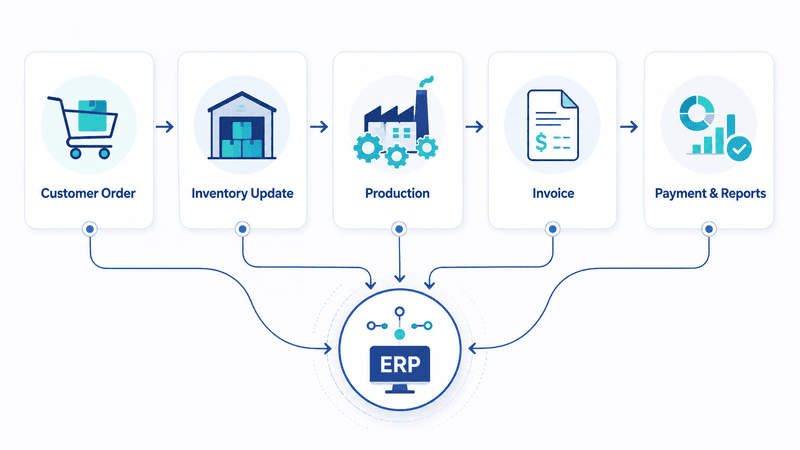
Let's look at a simple example.

A customer places an order.

The ERP system instantly:

  • Updates inventory
  • Sends the order to production
  • Creates the invoice
  • Records the payment
  • Updates business reports

No one has to enter the same information twice. This saves time and reduces mistakes.

Main Features of an ERP System

Most ERP solutions include these important modules.

Finance & Accounting

Manage invoices, expenses, payments, taxes, and financial reports in one place.

Inventory Management

Track stock levels in real time, manage warehouses, and avoid stock shortages.

Sales & CRM

Manage customers, quotations, sales orders, and deliveries without switching between different systems.

Human Resources (HR)

Store employee records, manage payroll, attendance, leave, and performance.

Reports & Dashboards

View real-time business reports and dashboards whenever you need them.

Why Do Businesses Use ERP?

Many businesses start with simple software.

As they grow, they add more tools.

One system for accounting.

Another for inventory.

Another for payroll.

Another for sales.

Soon, nothing is connected.

Employees waste hours copying information from one system to another.

ERP solves this problem by bringing everything together.

With one connected system, your business becomes faster, more organized, and easier to manage.

Benefits of ERP

A modern ERP system can help your business:

  • Save time
  • Reduce manual work
  • Improve teamwork
  • Reduce errors
  • Track inventory accurately
  • Generate reports instantly
  • Make faster decisions
  • Improve customer service
  • Support business growth

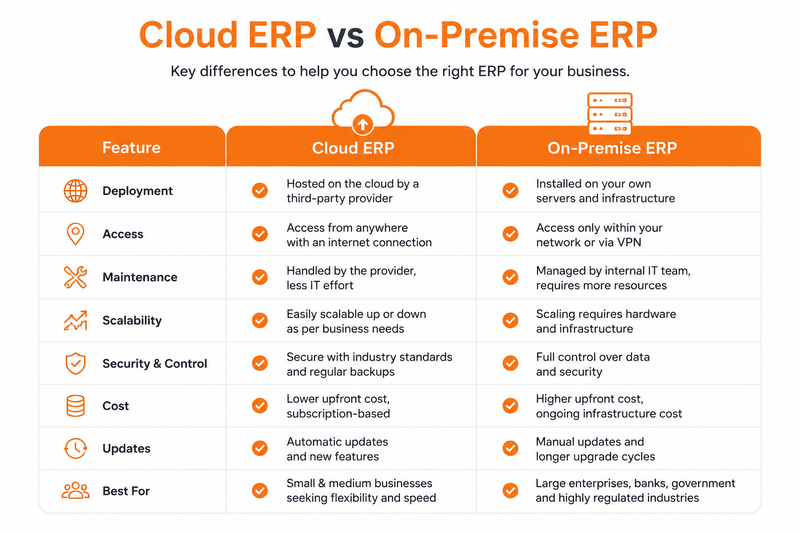
Today, businesses usually choose between 2 types of ERP

  1. Cloud ERP
  2. On-Premise ERP

Signs Your Business Needs ERP

You may need an ERP system if:

  • Your team uses too many software tools.
  • You still depend on spreadsheets.
  • Reports take too long to prepare.
  • Departments have different information.
  • Inventory records are often wrong.
  • Your business is growing quickly.
  • Your accounting software no longer meets your needs.

If you face these problems, ERP can help simplify your operations.

Why AI Is Changing ERP

Today, many ERP systems use Artificial Intelligence (AI) to automate daily tasks and provide better business insights.

AI can:

  • Predict future demand
  • Detect unusual transactions
  • Create smart reports
  • Reduce repetitive work
  • Help managers make faster decisions

Instead of only storing data, modern ERP systems help businesses use that data more effectively.

How to Choose the Right ERP

Before choosing an ERP system, ask yourself these questions.

  • Is it easy to use?
  • Can it grow with my business?
  • Does it support my industry?
  • Can it connect with my existing software?
  • Does it include AI features?
  • Will I get support after implementation?

Choosing the right ERP partner is just as important as choosing the software.

Final Thoughts

In 2026, businesses need more than separate software tools. They need one connected system that helps every department work together.

An ERP system gives you better control, better visibility, and better decisions.

With AI becoming a core part of modern ERP, businesses can automate routine work, reduce costs, and focus on growth.

If you're looking for a flexible ERP solution built for modern businesses, Business Brain by Betopia Group helps you manage finance, inventory, HR, sales, and operations in one powerful platform.

Whether you run a manufacturing company, retail business, educational institution, or service organization, Business Brain is designed to grow with you.

Ready to simplify your business? Explore Business Brain and discover how AI-powered ERP can help your business work smarter in 2026.

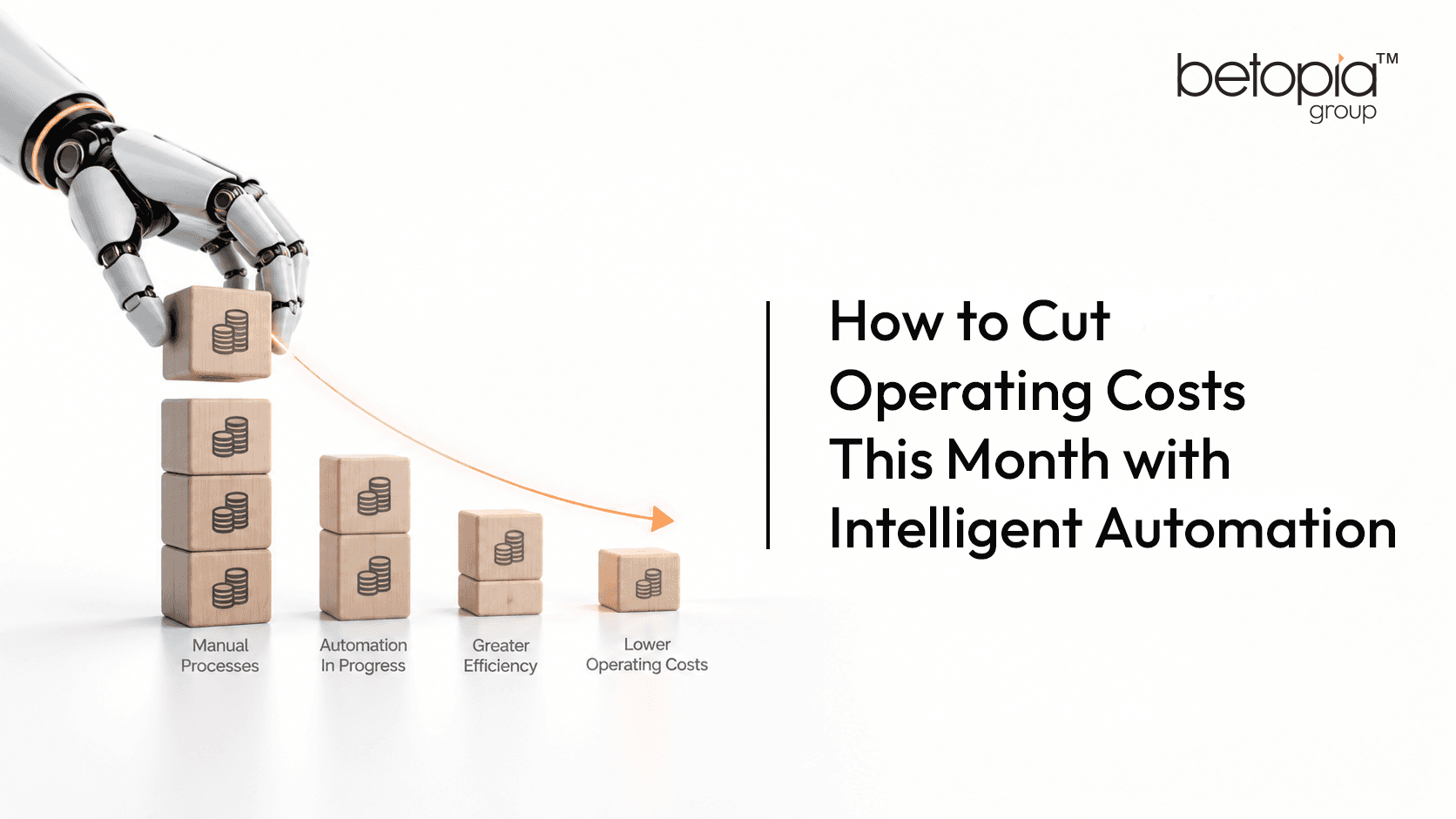
How to Cut Operating Costs This Month with Intelligent Automation
Industry Insights
Jul 22, 2026
Betopia Group

How to Cut Operating Costs This Month with Intelligent Automation

Discover how intelligent automation fixes hidden workflow problems, speeds up approvals, and slashes operating costs starting this month.

Imagine Saving Hours Every Week Without Hiring Extra Help

What if the biggest money drain in your business is hiding in plain sight?

Not in big fancy projects. But in small, boring daily tasks.

A team member typing the same invoice data into three different systems. Someone answering the same customer question over and over. A simple approval stuck in an inbox for days.

Many companies lose a surprising piece of their operating costs this way, without anyone noticing.

But from today you can start fixing it this month with intelligent automation. No giant overhaul needed. Just smart, simple tools that handle the repetitive work so your team can focus on what matters.

Why Operating Costs Keep Growing (Even When You’re Careful)

Costs don’t usually jump all immediately. They sneak up slowly.

Old processes that worked with a small team stop working well as you grow. Temporary fixes become permanent habits. One person’s complicated spreadsheet becomes a daily headache for everyone.

Most of these problems come from manual, repetitive tasks:

  • Typing the same data continually
  • Checking status updates
  • Waiting for approvals
  • Sending the same follow-up emails

These tasks aren’t hard but they’re expensive when they happen hundreds of times a week. The time and mistakes add up quickly.

What Is Intelligent Automation?

“Automation” is a big word, but it’s actually quite simple.

Basic automation follows strict rules: “If this happens, do that.” It helps, but it gets stuck easily.

Intelligent automation is smarter. It mixes simple rules with AI that can read documents, spot patterns, and make small decisions. It handles changes and exceptions instead of breaking.

Example:

With basic automation, an invoice goes from email to a queue.

With intelligent automation, the system reads any invoice, checks it against orders, sends it to the right person, and learns from mistakes.

This saves time and reduces expensive errors.

Four Easy Places to Start Saving Money Right Now

You don’t need a huge plan. Start with these four high-impact areas:

  1. Approval Expense reports and purchase requests often sit waiting. Smart workflows send them automatically, remind people, and speed everything up.
  2. Repeated Questions Support and HR teams answer the same questions dozens of times a day. An intelligent chatbot like Talkora AI can handle the simple ones 24/7, freeing your team for important conversations.
  3. Data Entry & Checking Typing information by hand causes mistakes that waste more time later. Intelligent tools can read documents, pull out the right info, check it, and move it forward with fewer errors.
  4. Reports & Compliance Pulling numbers from different systems every month is boring and time-consuming. Tools like Business Brain connect everything in one place so reports become fast and accurate.

Real Results You Can Expect

Many businesses wonder: “Does this really work?” The answer is yes and the results show up faster than most people expect.

You’ll see fewer mistakes, faster task completion, and happier teams. Employees stop wasting time on boring work and start doing more valuable jobs.

Common wins include:

  • Approval processes that used to take days now finish in hours
  • Data entry errors drop sharply
  • Teams answer routine questions instantly with AI help
  • Monthly reports that once took days are ready in minutes

How Fast Can You See Results?

Many people think automation takes months or years. That’s true for giant system changes.

But fixing everyday processes is comparatively faster.

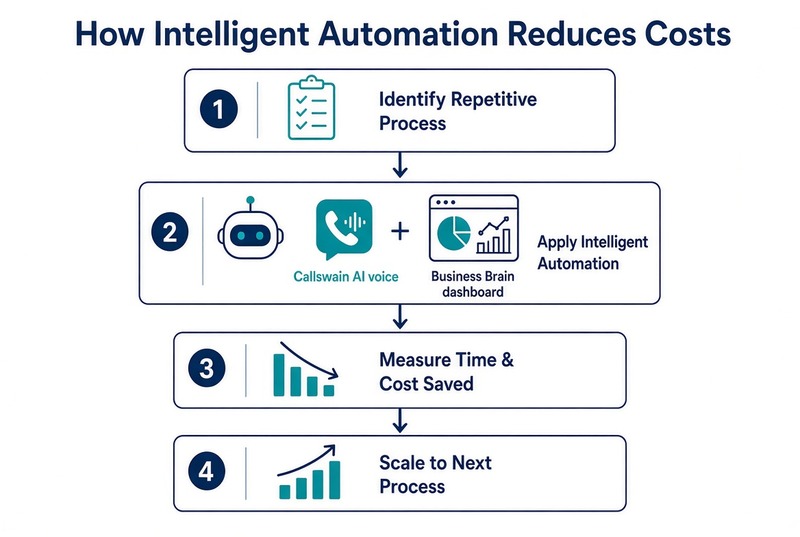
Many companies see real time savings in just weeks. Pick one clear, repetitive process. Automate it. Measure the time saved. Then move to the next one.

A Simple Way to Get Started

Before picking any tool, ask three quick questions about each process:

  • How often does it happen? (Volume)
  • How long does it take? (Time cost)
  • What happens when mistakes occur? (Error cost)

Choose the ones that score high on all three. These are usually the best places to start.

The real power comes when your tools work together. When automation, AI, and data systems connect smoothly, the savings grow bigger and faster.

Does AI Automation Replace People?

No. Intelligent automation removes boring, repetitive work. It lets your team spend time on creative thinking, solving problems, and building relationships.

Smaller companies often benefit even more because manual tasks eat up a bigger part of their day.

Ready to Cut Costs This Month?

Cutting operating costs doesn’t need a total business makeover. It starts with an honest look at where time is wasted on tasks that don’t need human judgment.

Intelligent automation gives you a clear, practical way to fix those leaks.

Start small. Measure the results. Watch the savings add up.

If you’re looking for integrated, AI-powered solutions that combine automation, smart data, and modern operations technology, Betopia Limited makes it effective. Their approach helps businesses of all sizes reduce costs, work smarter, and grow with confidence.

Custom Software vs. Off-the-Shelf Apps: Which Saves You More Money in 2026?
General
Jul 22, 2026
Betopia Group

Custom Software vs. Off-the-Shelf Apps: Which Saves You More Money in 2026?

Explore the real cost of custom software vs. off-the-shelf apps. Learn which solution delivers better savings, flexibility, and growth in 2026.

Your team wastes hours every week fighting software that almost works. You’re paying monthly fees that keep climbing. And switching feels like a nightmare.

Sound familiar?

Every growing organization hits this wall. The big question is always the same: Should you buy ready-made software or build something custom? In 2026, the answer isn’t simple but getting it right can save you serious money over the next few years.

Why This Decision Matters So Much

Ten different CFOs will give you ten different answers. That’s because they’re all looking at different parts of the total cost.

Off-the-shelf apps look cheap when you first sign up. Custom software looks expensive on day one. In the hidden fees, lost time, and workarounds that pile up.

This isn’t just about price tags. It’s about fit. Does the software work the way your team actually works? Over time, a good fit almost always wins on cost.

The Hidden Costs of Off-the-Shelf Software

Ready-made apps have clear advantages:

  • They’re ready to use right away
  • They’ve been tested by thousands of users
  • You get support and updates

But here’s what the sales team often skips: You’re buying someone else’s idea of how your business should run.

When your processes don’t match the software, costs start creeping in:

  • Rising license fees that grow faster than your team
  • Extra paid modules to fill missing features
  • Expensive work to connect it with your other tools
  • Staff time spent on manual fixes and workarounds
  • Painful (and costly) data moves if you ever switch

These extras rarely appear in the first quote. They show up quietly on future bills.

The Truth About Custom Software Costs

Custom software has the opposite story. The price is higher. You pay for planning, building, testing, and launching a system made exactly for your needs.

What you get back:

  • Software that matches your real workflows
  • No per-user license fees that explode as you grow
  • Full control
  • Easier connections between your different systems

Yes, it takes longer to launch than clicking “Subscribe.” But for organizations thinking 3–10 years ahead, custom often becomes the cheaper choice. You avoid years of paying for things that don’t quite work.

What Actually Decides Which Option Saves Money?

Ask yourself these honest questions before comparing prices:

  • How unique is your work? If your processes are standard for your industry, off-the-shelf can be cheaper. If your work is different (special compliance, unique operations, complex data needs), forcing a generic tool creates expensive problems.
  • How long will you use it? Short-term needs favor ready-made software. Long-term core systems favor custom because workarounds get very expensive over many years.
  • How important is integration? Custom systems can connect everything smoothly. This often saves more money than any single ready-made tool by cutting manual work between disconnected systems.
  • What happens when you grow? Per-user fees hurt growing organizations. Custom software usually scales without those extra charges.

How AI Is Changing Everything in 2026

Good news: Building custom software is faster and more affordable than it used to be. AI tools, reusable frameworks, and smart platforms have cut both time and cost dramatically.

Configurable platforms that can be adapted to your needs

How Betopia Group Helps You Choose Wisely

Betopia Group, We offer exactly this balanced approach. Instead of forcing you into one-size-fits-all software or starting from zero, We combine proven platforms with smart customization.

Our solutions include:

These platforms can be effective in how your organization actually works. Where needed, We layer in Agentic AI and Talkora AI to automate repetitive tasks and improve customer interactions.

The result? You get powerful, flexible systems that save money over time instead of creating new problems.

Making the Smart Choice

Skip the simple price comparison. Instead, look closely at your current systems. Where are teams losing time? Where are manual fixes slowing you down? Where will growth create new headaches?

Organizations that do this homework almost always make better long-term decisions.

Custom software is not always more expensive. It often costs more at the start, but can save money over years by removing recurring fees and workarounds.

Off-the-shelf software is not bad. It works well for standard needs.

AI has made custom options more realistic for more organizations.

Integration and scaling are usually where custom shines.

Map your current workflows and spot the real pain points. That single exercise often makes the right path obvious.

Ready to find the solution that actually fits your organization?

Betopia Group specializes in helping teams choose and build the right enterprise systems. If you need smart customization of proven platforms or deeper custom development, Our team delivers solutions that grow with you.

Visit Betopia Group today to explore Business Brain, Betopia EduOS, CareOS, and Our AI-powered tools. Stop paying for software that fights against you and start using systems built to help you.

What Is Agentic AI? The Complete Business Guide For 2026
Industry Insights
Jul 21, 2026
Betopia Group

What Is Agentic AI? The Complete Business Guide For 2026

A clear look at what agentic AI really means, how it differs from chatbots and automation, and what it can realistically do for your business in 2026.

What if the next big jump in work speed is not just a new tool, but a smart system that gets whole jobs done with you?

You can ask ten business leaders what “agentic AI” means and likely hear ten different answers.

Some say it is a better chatbot. Others think it is full automation that needs no humans at all.

Both ideas are wrong. This mix-up is costing companies real money today. They either spend too much on tools that do not fit or miss out on changes that are already happening.

Let’s make it clear.

What Agentic AI Really Means

Normal AI, like the chatbots you may have used, does one thing at a time.

You ask a question. It gives an answer. You ask it to write an email. It writes one. Then it waits for your next command.

It is different. It takes a goal and makes a plan. It decides the steps. It uses tools to finish the work. It checks what happens and changes its plan if needed. It does all this without you telling it every single step.

Picture the difference between a calculator and a helpful assistant.

A calculator gives you the answer to your exact question. A good assistant gets a goal and completes the full task. It may check facts, ask questions, and finish the job.

Agentic AI is like that smart assistant. It works to reach a goal, not just give one quick reply.

This is an important change for business. It turns AI from a simple helper tool into a system that can handle parts of work on its own, while people stay in charge.

Agentic AI vs Traditional Automation

People often mix up this tool with old-style automation. They are not the same.

Old automation uses fixed rules. If this happens, then do that. It is fast and works well for simple, repeating jobs. But when something new or unexpected comes up, it stops. A person must fix it.

This agent thinks more like a person. It looks at the full situation. It considers a few choices. It picks the best next step.

Good agentic systems still follow safety rules. They ask for help when unsure. They keep records so people can check everything.

The companies getting good results start with small, clear jobs. They keep strong human control instead of giving away everything.

Where Agentic AI Is Already Delivering Results

Successful deployments focus on specific, well-defined workflows not entire departments.

Here’s where it’s working right now:

  • Healthcare: Agentic assistants pull patient history, draft notes, and flag issues. Tools like CareOS cut paperwork so clinicians spend more time with patients.
  • Financial Services: Agents reconcile accounts, spot problems, and build reports in minutes instead of days.
  • Customer Engagement: Platforms like Talkora AI understand intent, pull data, solve simple requests, and hand off complex ones with full context.
  • Higher Education: Institutions use Betopia EduOS for admissions follow-ups, advising support, and admin coordination.
  • Enterprise Operations: Systems like Business Brain monitor data, handle routine actions, and surface exceptions while keeping humans in control.

How to Start Using Agentic AI

Start by looking at your own team. Find tasks that happen often, follow clear steps, and have few surprises.

Do not try to change everything at once. Pick one small area. Test it. Measure the results. Fix any problems. Then grow slowly to other areas.

Always set clear rules. Keep full control. Make sure people can see what the AI is doing and stop it if needed.

Smart Tips for Success

  • Begin with easy tasks to build confidence.
  • Measure results with simple numbers like time saved or errors reduced.
  • Ask your team for honest feedback.
  • Train everyone how to work with the new AI.
  • Add safety rules from the first day.

Following these tips helps you get real value without big risks.

What This Means for Your Business

You do not need to ask if you should use agentic AI.

Ask instead: Which repeating jobs are taking too much time from my team?

Look for tasks that happen often, are well known, and have few surprises. These are great places to start.

Begin small. Try one area first. Get quick wins. Then grow slowly.

Always set clear rules for what the agent can do. Make sure you can see everything it does. Keep easy ways for people to step in and fix things.

Do not give big judgment calls, legal work, or trust-heavy jobs to AI too early. Build confidence with easy tasks first.

Here are extra tips: Pick one team or process to test. Measure results with simple numbers. Ask your team for feedback. Make quick improvements. Train everyone how to work well with the new agents.

Closing Thoughts on Agentic AI

Agentic AI is a real step forward in work. It gives your team back hours now lost on dull tasks. It does this while keeping people in control and responsible.

The smartest companies will not be the fastest. They will be the ones who pick good starting tasks, prove it works, and grow carefully.

This smart way brings lasting success without big problems.

If your team has not yet checked where it can help, start that work now. The difference between early users and others is growing fast.

Betopia Group builds helpful solutions for many industries. Their tools include CareOS for healthcare, Betopia EduOS for education, Business Brain for operations, and more. They help companies use it in safe, useful ways that bring real results.

How to Use AI for Customer Support Without Sacrificing Customer Experience
Industry Insights
Jul 21, 2026
Betopia Group

How to Use AI for Customer Support Without Sacrificing Customer Experience

Learn how to automate customer support in 2026 with AI chatbots and Talkora AI, keeping every conversation fast, personal, and truly helpful.

Imagine This…

It’s 11 p.m. A tired customer sends a message about a wrong charge. No one answers.

By morning, they’re angry, they’ve left a bad review, and they’ve switched to your competitor.

This happens sometimes.

That’s why smart businesses are automating customer support. But here’s the point: bad automation makes things worse. It turns helpful chats into frustrating loops where customers keep shouting, “Talk to a human!”

The good news? In 2026, you can automate support and still feel like a human. Let’s see exactly how.

Why Automation Is No Longer Optional

Today’s customers want fast service any time, day or night. They expect you to already know their order, their past chats, and their account details.

No human team can do all that 24/7 at a big scale.

Automation steps in to handle the simple stuff so your team can focus on the hard, important conversations.

What “Human Touch + Automation” Really Means

Automation and kindness are not enemies.

A good AI chatbot doesn’t need to pretend it’s a person. It just needs to be:

  • Quick and accurate
  • Understanding of the situation
  • Honest when it needs to bring in a real human

Customers don’t hate bots. They hate bots that waste their time.

This is exactly how platforms like Talkora AI work. It understands what the customer really wants, remembers the whole conversation, and smoothly hands off to a human when things get tricky.

The Real Benefits of Blending AI with Human Support

Businesses that use both AI and human agents enjoy clear benefits in 2026. AI answers simple questions instantly, even late at night. Customers get help right away instead of waiting until the next day.

AI also helps reduce costs. It handles routine questions so your team does not spend time on the same simple tasks. This gives your support staff more time to solve difficult problems that need real care and smart thinking. As a result, customers feel happier and your team feels more satisfied.

Another major advantage is growth. Whether you have 100 or 10,000 customers a day, the system can easily grow with your business without tiring out your team. The AI can also remember customer history and past issues to give more helpful, personal answers. In the end, your support becomes both fast and caring.

How to Build a Support System That Actually Works

Here’s a simple, step-by-step plan:

1. Start with real questions, not fancy tech

Look at your support tickets from the last 6 months.

Most are the same: “Where’s my order?”, “Reset my password”, “How do I book an appointment?”

Automate these first.

2. Make escalation easy

The best systems don’t try to handle every problem. If a customer sounds angry, confused, or the issue is serious, the AI quickly passes them to a real person with all the details already shared.

3. Use friendly, natural language

Skip robotic scripts. Choose AI that talks like a helpful friend with clear, warm, and ready to ask questions if something is unclear.

4. Add personal touches

Great automation uses customer history. It can say, “I see you ordered the blue shoes last week…” instead of generic answers. This makes it feel caring, not cold.

5. Keep improving it

Treat your AI like a new team member. Read its chats, fix mistakes, and update it often as your products and policies change.

Where Real Humans Still Need

Automation handles the boring, repetitive work.

Your human team gets freed up for what they do best: solving tricky problems, calming upset customers, and building real loyalty.

Everyone wins.

Quick Self-Check for Your Business

Ask yourself these three questions:

  • Which chats are simple and happen over and over?
  • Where do customers get frustrated repeating themselves?
  • How fast can someone reach a real person when they need one?

Your answers will show exactly where to start.

AI Support Trends in 2026 and Beyond

The future of customer support will be even smarter. AI is already getting better at understanding customer feelings. It can also offer proactive help, such as reminding customers about shipping delays before they ask. Plus, it works smoothly across chat, voice, and email.

Voice-powered AI agents and better personalization (while fully protecting customer privacy) are becoming normal. Businesses that start building strong AI and human support systems today will have a clear advantage as customer expectations keep growing.

The most important thing will always stay the same: use technology to remove problems and give your human team more time to build real connections with customers.

Final Thoughts

Automating customer support in 2026 isn’t about replacing people. It’s about using AI to remove frustration and give your team time for the conversations that truly matter.

Automation makes support faster, kinder, and more available around the clock.

If your current support feels slow or stressful, now is the perfect time to map your common questions and explore tools like Talkora AI that balance smart automation with real human care.

At Betopia Group, we help businesses like yours implement smart AI customer support solutions that boost efficiency while keeping every interaction warm and human. Ready to transform your support experience in 2026? Let’s build a system that works for you.

How to Scale Engineering Without the Hiring Drag
General
Jul 7, 2026
Team Betopia

How to Scale Engineering Without the Hiring Drag

Every ambitious roadmap eventually meets the same wall: the work the business has committed to is bigger than the team it has to build it. A new AI product needs a machine-learning specialist the company does not employ. A cloud migration stalls because the two architects who understand the stack are already booked for the next two quarters. A release date is set, then quietly moved, then moved again not because the plan was wrong, but because the capacity was never there.

Hiring is the obvious answer, and often the wrong one. A senior engineer takes weeks to source, months to close, and longer still to become productive. By the time the seat is filled, the window that made the hire urgent has usually closed. This is the gap that resource augmentation and team augmentation are built to close and understanding how they work, and when to use them, is now a core part of how competitive engineering organizations plan.

What Resource Augmentation Actually Means

Resource Augmentation often called staff or team augmentation, is a model for adding skilled engineering talent to your existing team on demand, without carrying the cost and delay of permanent hiring. The augmented professionals work as an extension of your in-house team: inside your workflows, on your tools, reporting into your leadership, aligned to your release schedule.

The distinction that matters is control. In augmentation, the client keeps ownership of the roadmap, the priorities, and the day-to-day direction. You are not handing a problem to an outside vendor and waiting for a result. You are adding capability to a team you continue to run.

That single characteristic separates augmentation from most other engagement models, and it is the reason technology leaders reach for it when the work is core to the business rather than peripheral to it.

The Models You Can Choose

Augmentation is not one arrangement but several, and the right one depends on what you are missing.

  • Dedicated engineering squads suit organizations that need sustained capacity a full team aligned to their tech ecosystem, embedded into standups, sprints, and release cycles, working under the client's direct management for the length of a program.
  • On-demand niche experts suit a narrower, sharper need a senior cloud architect, a deep-learning engineer, a cybersecurity audit specialist brought in to unblock a specific problem. Here the value is not headcount but depth: a certified veteran who has solved the exact problem before.
  • Project-based and skill-based augmentation sit between the two, letting teams flex up for a defined phase — a migration, an integration, a product launch and flex back down when it ends.

The models can also be layered by delivery location. Onshore talent offers time-zone proximity; offshore talent offers scale and cost efficiency; a blended arrangement offers both. The point is that augmentation is configurable to the shape of the gap, not a single fixed package.

When Augmentation Is the Right Call

Augmentation earns its place in specific situations, and recognizing them early is what separates teams that ship on time from teams that explain why they didn't.

It fits when a critical skill is missing and hiring for it permanently isn't justified the need is real but time-bound. It fits when a deadline is fixed and the current team, however capable, cannot reach it alone. It fits when demand is genuinely variable, and locking in permanent headcount for a temporary peak would leave the organization overstaffed once the peak passes. And it fits when speed is the constraint: augmented specialists can often be integrated in a fraction of the time a full recruitment cycle would take.

It is the wrong call when the need is permanent and central a role the company will always require is usually better filled by hiring. Good augmentation partners will say so, because the goal is the right capacity, not the largest contract.

The Benefits That Told Up

The case for augmentation is practical rather than theoretical.

  • Speed to capability. The most valuable thing augmentation buys is time. Talent that is already vetted and available can be onboarded in weeks rather than the months a permanent search demands.
  • Access to depth. Augmentation gives smaller and mid-sized teams access to senior, specialized expertise cloud, AI, security, data that would be difficult or expensive to hire full-time.
  • Flexibility without overhead. Because contracts are matched to project cycles, organizations scale up for the work and scale down when it ends, without the fixed cost, payroll burden, and operational overhead of permanent staff.
  • Retained control. Unlike full outsourcing, the client keeps direction of the work. The team grows; the ownership does not move.

The Pitfalls And How to Avoid Them

Augmentation fails when it is treated as a transaction rather than an integration. The common failure modes are predictable, which means they are preventable. Poorly integrated talent engineers who sit outside the team's workflows, tools, and communication produce work that has to be reconciled later, erasing the speed advantage. The fix is deliberate onboarding: shared repositories, shared Slack and ticketing, shared standups, and clear ownership from day one.

Vague requirements produce mismatched talent. If the exact stack and seniority level aren't defined before matching begins, the wrong person arrives and the timeline suffers. Rigorous requirement discovery upfront prevents it.

And thin quality assurance turns a fast start into slow rework. Continuous testing and clear code standards keep augmented capacity from becoming technical debt.

The pattern across all three: augmentation works when the augmented team is treated as part of the team, held to the same standards, and given the same context.

Augmentation Is Not Outsourcing

It is worth being precise, because the terms are often blurred. Outsourcing and managed services hand a defined outcome to an external provider who owns the delivery and, usually, the method. That is the right choice for work that is non-core, well-bounded, and better run by someone else.

Augmentation is the opposite arrangement. The client owns the outcome and the direction; the partner supplies the people who help reach it. When the work is close to the heart of the business the product, the platform, the roadmap most leaders want to keep that control. Augmentation lets them scale without giving it up.

How Betopia Approaches It

At Betopia, resource augmentation is built for one thing: rapid engineering scale without operational drag. Our model rests on top 1% pre-vetted senior talent, evaluated not only for technical skill but for logical reasoning and the soft skills that let an engineer integrate into an existing team quickly and cleanly.

We work through two core offerings.

  • Dedicated developer teams are custom engineering squads aligned to your ecosystem, integrated into your workflows, standups, and release schedules under your direct management.
  • On-demand niche experts - senior cloud architects, deep-learning specialists, cybersecurity auditors are placed to unblock specific, high-stakes problems, often within two weeks.

The engagement follows a proven four-step method: requirement discovery to map the exact stack and seniority needed; talent matching to handpick and interview the right specialists; secure onboarding into your repositories and communication channels; and then continuous, managed delivery as the team scales with your work. Talent is typically onboarded within two to four weeks, with data confidentiality and IP protection built into every engagement.

That discipline is backed by scale and by standards. Betopia brings 5,000+ professionals across 22+ strategic business units, delivery to organizations in 80+ countries, and more than 85,000 projects completed since 2013 supported by ISO 9001, ISO 27001, and ISO 20000 certifications and delivery across Bangladesh, the UAE, the US, the Philippines, and Australia.

The Future of Aviation: How AI is Transforming Flight Operations
Aviation
Jan 1, 2025
Betopia Editorial Team

The Future of Aviation: How AI is Transforming Flight Operations

Redefining Aerospace with Artificial Intelligence

The aviation industry is on the brink of a massive transformation powered by Artificial Intelligence (AI). From predictive maintenance to autonomous flight systems and optimized routing, AI is fundamentally changing how airlines operate and ensuring unprecedented levels of safety and efficiency.

Predictive Maintenance and Safety

One of the most significant applications of AI in aviation is predictive maintenance. Traditional maintenance schedules rely on routine checks based on flight hours. However, AI-driven systems continuously monitor thousands of data points from aircraft sensors in real-time. By analyzing this data, machine learning algorithms can predict component failures before they occur, drastically reducing aircraft downtime and preventing in-flight emergencies.

  • Reduced Delays: Identifying issues early prevents last-minute groundings.
  • Cost Savings: Airlines save millions by avoiding catastrophic engine failures and optimizing part replacements.
  • Enhanced Safety: Continuous monitoring ensures that anomalies are flagged immediately.

Optimized Flight Routing

Flight routing is complex, involving weather patterns, air traffic, and fuel efficiency constraints. AI models process massive amounts of historical and real-time weather data to determine the most efficient flight paths. This not only reduces fuel consumption—a major cost for airlines—but also minimizes carbon emissions, pushing the industry towards greener operations.

The Road to Autonomous Flight

While fully autonomous commercial flights might still be a few years away, AI is already powering advanced autopilot systems and assisting pilots during critical phases of flight. AI acts as a reliable copilot, handling routine tasks and allowing human pilots to focus on high-level decision-making and safety.

"Artificial Intelligence in aviation isn't just about automation; it's about augmenting human capability to achieve zero-defect operations." - Betopia Group Aviation Experts

Conclusion

As airlines look to bounce back and grow in a competitive market, adopting AI technologies is no longer optional—it's essential for survival. From the tarmac to the stratosphere, AI is ensuring that the future of flight is safer, cleaner, and more efficient than ever before.

Smart Manufacturing in the Automotive Industry: The Industry 4.0 Revolution
Automotive
Jan 1, 2025
Betopia Editorial Team

Smart Manufacturing in the Automotive Industry: The Industry 4.0 Revolution

Driving the Next Era of Vehicle Production

The automotive industry is undergoing a paradigm shift driven by Industry 4.0 technologies. Smart manufacturing, leveraging Artificial Intelligence, the Internet of Things (IoT), and robotics, is redefining how vehicles are designed, produced, and delivered to consumers. This digital transformation is enabling unprecedented flexibility, efficiency, and quality control.

The Role of IoT and Digital Twins

In a modern automotive plant, every machine, robot, and conveyor belt is interconnected via IoT sensors. This connectivity allows for the creation of "Digital Twins"—virtual replicas of the physical manufacturing environment. By simulating production processes in real-time, manufacturers can identify bottlenecks, test new configurations, and optimize workflows without disrupting actual production.

AI-Powered Quality Assurance

Quality control has traditionally been a manual, time-consuming process prone to human error. Today, AI-powered computer vision systems inspect vehicles with microscopic precision on the assembly line. These systems can instantly detect paint defects, misaligned panels, or faulty welds that human eyes might miss, ensuring that only flawless vehicles reach the showroom floor.

  • Zero-Defect Manufacturing: AI drastically reduces the margin of error in automotive assembly.
  • Adaptive Robotics: Collaborative robots (cobots) work alongside human operators, dynamically adjusting their actions based on real-time data.
  • Supply Chain Optimization: Predictive algorithms forecast parts demand, preventing assembly line halts due to inventory shortages.
"The cars of tomorrow require the factories of tomorrow. Smart manufacturing is the engine powering the electric and autonomous vehicle revolution." - Betopia Group Automotive Experts

Conclusion

As consumer demand shifts towards electric and customized vehicles, the flexibility offered by smart manufacturing is critical. The automotive industry is no longer just about heavy machinery; it is a highly advanced technology sector where data is just as important as steel.

The Next Generation of Banking: AI, FinTech, and Cybersecurity
Banking
Jan 1, 2025
Betopia Editorial Team

The Next Generation of Banking: AI, FinTech, and Cybersecurity

Redefining Trust and Efficiency in Financial Services

The banking sector is experiencing a massive disruption spearheaded by FinTech innovations and Artificial Intelligence. As customer expectations evolve towards instant, digital-first experiences, traditional banks are rapidly transforming into agile technology companies to stay relevant and secure.

AI in Fraud Detection and Risk Management

Security is the bedrock of banking. Traditional rule-based fraud detection systems are no longer sufficient against sophisticated cybercriminals. Today, banks employ advanced machine learning algorithms that analyze millions of transaction patterns in real-time. These AI systems can detect anomalous behavior and block fraudulent transactions instantly, minimizing false positives and protecting consumer assets.

Hyper-Personalization in Retail Banking

Consumers expect banks to understand their financial needs proactively. By leveraging Big Data and AI, banks are offering hyper-personalized services.

  • Predictive Financial Insights: AI analyzes spending habits to provide tailored budgeting advice.
  • Robo-Advisors: Automated algorithms provide low-cost, optimized investment strategies for retail investors.
  • Intelligent Chatbots: AI-powered virtual assistants resolve customer queries instantly, 24/7.

The Shift to Decentralized Finance (DeFi)

Blockchain technology is moving beyond cryptocurrencies and is being integrated into core banking infrastructure. Smart contracts enable automated, trustless transactions, reducing the need for intermediaries in processes like loan approvals and international remittances, significantly lowering costs and settlement times.

"In the digital age, a bank's most valuable asset is no longer capital, but the data and trust of its customers." - Betopia Group Banking Experts

Conclusion

The future of banking lies in the seamless integration of AI-driven personalization and impenetrable cybersecurity. Financial institutions that successfully navigate this digital transformation will not only survive but thrive in the highly competitive global economy.
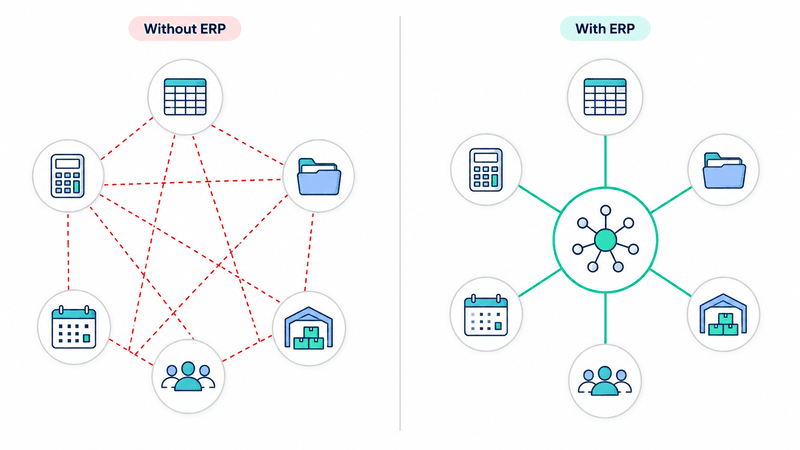
Transforming Patient Outcomes: Predictive AI in Healthcare
Healthcare
Jan 1, 2025
Betopia Editorial Team

Transforming Patient Outcomes: Predictive AI in Healthcare

Moving from Reactive to Proactive Medicine

Healthcare is undergoing a data-driven revolution. Artificial Intelligence is shifting the paradigm from reactive treatments to proactive, predictive care. By analyzing vast amounts of patient data, AI is enabling early diagnoses, personalized treatment plans, and dramatically improved patient outcomes.

Early Disease Detection

One of the most powerful applications of AI in healthcare is in medical imaging and diagnostics. Machine learning algorithms can analyze X-rays, MRIs, and CT scans with a level of accuracy that often surpasses human experts. AI can detect subtle anomalies—such as early-stage tumors or signs of diabetic retinopathy—long before symptoms appear, allowing for early intervention when treatments are most effective.

Genomics and Personalized Medicine

No two patients are identical, and their treatments shouldn't be either. AI is crucial in deciphering the human genome rapidly and cost-effectively.

  • Targeted Therapies: By understanding a patient's genetic makeup, doctors can prescribe medications that will be most effective for them, minimizing trial-and-error.

  • Drug Discovery: AI significantly accelerates the pharmaceutical R&D process by predicting how different compounds will interact, bringing life-saving drugs to market faster.
  • Predictive Analytics: Hospitals use AI to predict patient admission rates, optimizing staff allocation and ensuring resources are available when needed most.
"AI is the stethoscope of the 21st century. It allows us to hear the hidden patterns in patient data and save lives proactively." - Betopia Group Healthcare Experts

Conclusion

The integration of AI in healthcare promises a future where medicine is highly personalized, incredibly precise, and universally accessible. As these technologies mature, they will continue to break down barriers to care and extend human longevity.

The Rise of InsurTech: Data-Driven Underwriting and Claims
Insurance
Jan 1, 2025
Betopia Editorial Team

The Rise of InsurTech: Data-Driven Underwriting and Claims

Modernizing the Insurance Landscape with AI

The insurance industry, historically known for legacy systems and manual processes, is being rapidly modernized by InsurTech. Leveraging Artificial Intelligence, Big Data, and IoT, insurance companies are automating underwriting, accelerating claims processing, and offering highly personalized policies.

Dynamic Pricing and Telematics

Gone are the days of blanket insurance premiums based on broad demographic data. Today, auto insurers use telematics—IoT devices installed in vehicles or smartphone apps—to track driving behavior in real-time. Safe drivers are rewarded with lower premiums, while AI algorithms dynamically adjust pricing based on actual risk rather than historical approximations.

Automated Claims Processing

Filing an insurance claim used to be a tedious, weeks-long process. Now, AI is automating claims from start to finish.

  • Instant Damage Assessment: Policyholders can upload photos of a car accident or property damage via an app. AI computer vision instantly assesses the damage and estimates repair costs.
  • Fraud Detection: Machine learning algorithms analyze claims data against vast databases to identify suspicious patterns, stopping fraudulent claims before payouts occur.
  • Touchless Claims: For simple claims, AI handles the entire process without human intervention, issuing payouts in seconds.
"InsurTech transforms insurance from a necessary burden into a proactive service that actively helps clients manage and mitigate risk." - Betopia Group Insurance Experts

Conclusion

By embracing AI and data analytics, the insurance industry is becoming more efficient, customer-centric, and profitable. The future of insurance lies in real-time risk assessment and seamless, instantaneous customer experiences.

Next-Gen Logistics: Building Resilient Supply Chains with AI
Logistics
Jan 1, 2025
Betopia Editorial Team

Next-Gen Logistics: Building Resilient Supply Chains with AI

Optimizing the Global Flow of Goods

In a hyper-connected world, supply chain disruptions can have catastrophic economic impacts. The logistics industry is turning to Artificial Intelligence and advanced analytics to build resilient, transparent, and highly optimized supply chains that can adapt to global shocks in real-time.

Demand Forecasting and Inventory Management

Maintaining the perfect balance of inventory is a massive challenge. AI models analyze historical sales data, weather forecasts, social media trends, and economic indicators to predict consumer demand with astonishing accuracy. This allows retailers and manufacturers to position inventory strategically, reducing holding costs and preventing stockouts.

Route Optimization and Autonomous Fleets

The "last mile" of delivery is notoriously the most expensive and complex. AI optimizes delivery routes dynamically, accounting for traffic, weather, and delivery windows.

  • Fuel Efficiency: Optimized routing drastically reduces fuel consumption and carbon footprint.
  • Warehouse Automation: AI-powered robots manage inventory storage and retrieval, speeding up order fulfillment tenfold.
  • Autonomous Delivery: Self-driving trucks and delivery drones are moving from concept to reality, promising 24/7 delivery capabilities.
"A smart supply chain is a competitive weapon. It turns logistical challenges into strategic advantages." - Betopia Group Logistics Experts

Conclusion

The logistics industry is the backbone of global commerce. By integrating AI and autonomous technologies, logistics providers are creating agile supply chains capable of delivering faster, cheaper, and more reliably than ever before.

AI in Consumer Goods: Hyper-Personalization and Smart Retail
Consumer Goods
Jan 1, 2025
Betopia Editorial Team

AI in Consumer Goods: Hyper-Personalization and Smart Retail

The Digital Transformation of the Retail Experience

The Fast-Moving Consumer Goods (FMCG) and retail sectors are experiencing a tectonic shift driven by consumer expectations and Artificial Intelligence. Modern consumers demand personalized experiences, seamless omnichannel purchasing, and instant gratification. AI is the key to delivering on these demands.

Hyper-Personalization and Customer Sentiment

Retailers are utilizing AI to understand their customers on a granular level. Recommendation engines analyze browsing history, past purchases, and even mouse movements to curate personalized product feeds. Furthermore, Natural Language Processing (NLP) algorithms analyze social media and product reviews to gauge consumer sentiment, allowing brands to adapt their product lines rapidly.

Smart Shelves and Cashless Stores

The physical retail experience is being digitized.

  • Cashless Checkout: AI-powered computer vision tracks what items a shopper puts in their cart, charging their account automatically as they walk out the door.
  • Smart Shelves: IoT-enabled shelves monitor inventory levels in real-time, alerting staff when restocking is necessary.
  • Dynamic Pricing: Electronic shelf labels update prices dynamically based on demand, time of day, or competitor pricing.
"In the modern retail landscape, the most successful brands are those that anticipate consumer needs before the consumer even realizes them." - Betopia Group Consumer Goods Experts

Conclusion

The intersection of technology and retail is creating an era of unprecedented convenience and personalization. Consumer goods companies that harness the power of AI will dominate the market by delivering exactly what consumers want, exactly when they want it.